
Nishimuraya Honkan
西村屋本館
Does Nishimuraya Honkan allow tattoos? Yes!
Stay here and Kinosaki’s seven public bathhouses are free with the Yumepa pass you get at check-in — tattoos welcome, nothing to cover. The ryokan’s own baths have no published rule, so ask when you book.
Mandara-yu is two minutes away on foot, Goshono-yu five and Jizo-yu, the farthest, twelve.
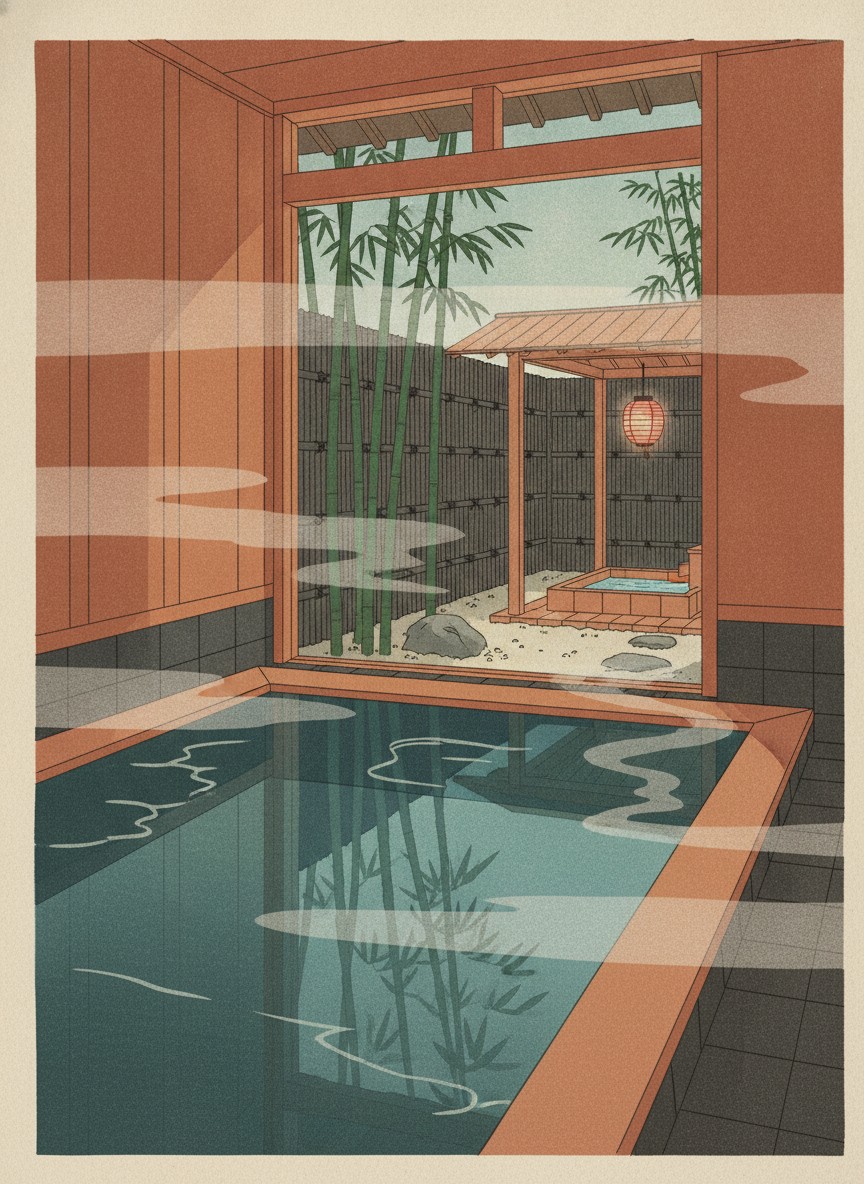
The bath
There are three bath halls, each built in a different style. Yoshi-no-yu is lined in hinoki cypress from the tub to the walls and ceiling, and outside it an open-air bath under an arbor roof sits in a bamboo garden that is lit after dark. Fuku-no-yu borrows from Chinese paving: pale tiles, a round indoor tub, round windows, the character for good fortune set into the floor, and a rock-built open-air bath. Nao-no-yu, in the separate Hiratakan wing, is an indoor bath with windows onto that wing’s courtyard garden.
The water is piped from a source near Onsenji temple. The ryokan lists it as a mildly salty spring, heated and diluted. The baths are open 3 p.m. to 12:30 a.m. and again 5:30 a.m. to 10:30 a.m.
For bathing alone, several rooms have an open-air bath of their own (Hatsune, Asuka, Sakura, Kumoi and Honjin in the main house, Hourai and Kangetsu in Hiratakan) and Matsu, Ume and Botan a semi-open-air one. Ginsen and Yamabuki have an indoor hinoki bath, and Wakakusa and Hagoromo a hinoki or Shigaraki tub. Honkan guests can also book one of three private open-air spa suites at the sister hotel Shogetsutei, a ten-minute walk or a free ride away.
The hotel
Twenty-nine rooms, arranged around the garden so each looks onto it from its own angle. Hiratakan was built in 1960 by the sukiya (tea-house style) master carpenter Hirata Masaya, whose other work includes tea rooms at Daitokuji and the Kitcho restaurants. A display room holds gifts to the house over its history, among them calligraphy by Ito Hirobumi and ceramics by Kitaoji Rosanjin.
Good to know
- No children under 10 (since April 2024).
- In-room baths are filled with heated tap water, not hot-spring water — Kinosaki conserves its spring for the bathhouses and the inns’ large baths.
Getting there
Kinosaki-Onsen STN · JR San’in line
About 15 minutes on foot.
From Osaka, the Kounotori limited express reaches Kinosaki-Onsen in about 2 hours 40 minutes; the Kinosaki runs from Kyoto and the Hamakaze from Sannomiya and Himeji. The ryokan association’s free bus runs from the station forecourt to each inn; tell the ryokan your arrival time. Drop your bags at the inn information office by the station (¥200 per bag) and they’ll be delivered to the ryokan.
Where it is

Kinosaki-Onsen STN
- Shinkansen tickets Seats between any two stations, booked by date.
- JR Kansai Wide Area Pass ¥12,000 · 5 days Worth it if you’re riding the Kounotori to Kinosaki and back.
- Japan Rail Pass from ¥53,000 · 7, 14 or 21 days For a trip that takes in several regions by Shinkansen and JR lines.
Why a ryokan appears under “nothing to cover”
Staying here is what makes the public bathhouses free: ryokan in Kinosaki normally hand a yumepa pass to guests at check-in. How Kinosaki’s Yumepa system works →
What happens when you arrive
Pick up your Yumepa at check-in and walk to any of the public bathhouses; there’s nothing to cover there. Ask before using the ryokan’s own baths.
How we know
Confirmed from official site (town policy for the sotoyu); the ryokan publishes no rule for its own baths
Best for: couples who want the town’s flagship garden ryokan, 165 years old
Book your stay
- BBooking.comCheck availability
- AAgodaCheck availability
- EExpediaCheck availability
- HHotels.comCheck availability
Booking through these links costs you nothing extra and earns us a small commission, which keeps this guide free and up to date for our tattoo community. Thanks for your support.