
Satoyama no Kakureyado Kafutei
里山の隠れ宿 花富亭
Does Satoyama no Kakureyado Kafutei allow tattoos? In a private bath
Kafutei is a 19-room inn in the rice fields of Kikuka, and eleven of its rooms have a pottery or open-air tub of source water on the deck, including three second-floor rooms the inn rebuilt for guests who would rather not use the shared bath.
No tattoo rule is published. Eleven of the 19 rooms have an open-air or semi-open-air bath of their own on the deck, filled from the source, and the inn says the second-floor semi-open-air rooms were rebuilt for people who find the shared bath hard to use, so a tattooed guest can book one of those and leave the Hana-no-yu hall alone.
The bath
Kikuka Onsen, the inn says, has about 1,300 years of history, and its water is an alkaline simple spring with a trace of radioactivity, 53.7°C at the source and pH 9.7. The inn's onsen sommelier describes the alkaline slickness as a feeling of soapy water on the skin and credits the water with easing tiredness, rough skin and joint pain. In the halls it is run kakenagashi (spring water that flows through the tub and isn't reused) with nothing added.
The shared hall, Hana-no-yu, has an indoor bath with a ridged wooden floor that the inn says is hard to slip on, under bare roof beams, and an open-air bath that looks across the Kikuka fields to the hills, with a sauna on the open-air side. Bathing hours are 3 p.m. to midnight and 6 to 10 a.m., with shampoo, razors, toothbrushes and towels provided, and a lounge of sofas and massage chairs outside the door.
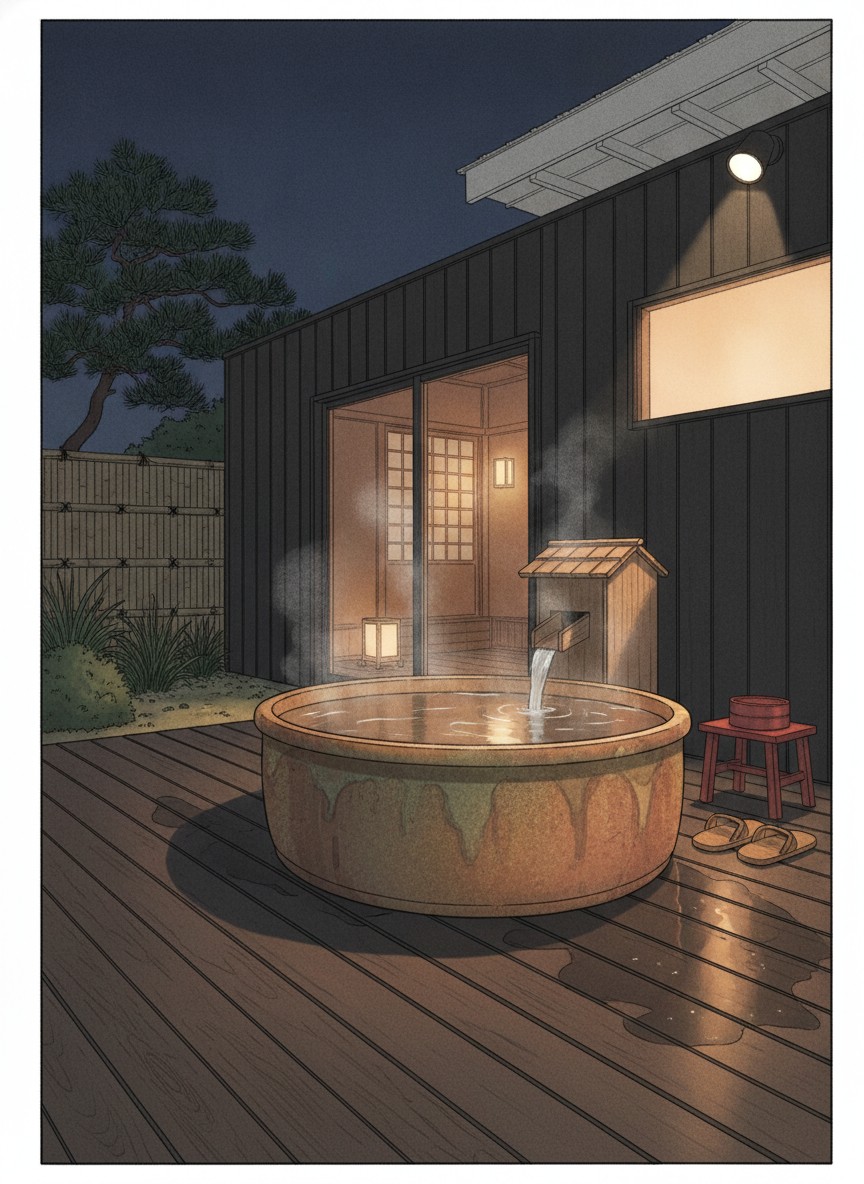
Eleven rooms have a tub of their own. Five Japanese-Western special rooms on the ground floor have an open-air bath on the deck, source water that the inn says is slightly diluted to hold the temperature; two universal-design special rooms, redone in summer 2023, have an open-air bath and two beds. On the second floor, three special rooms rebuilt in autumn 2024 have a semi-open-air pottery bath over the fields, and the inn says it made them for guests who cannot easily use a shared bath. The Japanese room Momiji has a roofed semi-open-air pottery tub on its deck. All of them can be used at any hour.
The hotel
Nineteen rooms, renovated in stages from October 2017, with a tatami lobby the inn asks you to cross barefoot. Dinner and breakfast are in the Risoan dining room, with a semi-private room and banquet halls for groups; the kitchen cooks a kaiseki (a multi-course Japanese meal) of Kumamoto country food such as Aso red beef, horse sashimi, salt-grilled yamame trout and local vegetables. The Ruri lounge serves matcha at check-in and drinks at night, and the courtyard has a foot bath of spring water. Check-in 3 p.m. with the last arrival at 9 p.m., check-out 11 a.m. Free parking for 50 cars. The inn belongs to the Airakanko group.
Good to know
- Eleven of nineteen rooms have their own tub, open-air on the ground floor and pottery semi-open-air upstairs.
- The 2024 second-floor rooms were built for people who avoid the shared bath, in the inn's own words.
- The shared hall has a sauna on the open-air side, open until midnight.
- A foot bath of spring water sits in the bamboo courtyard off the lobby.
Getting there
The inn's own public transport route starts at JR Tamana Station: the bus toward Yamaga for about 40 minutes to the terminus, then about 15 minutes by car. From Shin-Tamana the city's guide puts the Kyushu Sanko bus to Yamaga bus center at about 50 minutes, and the inn's 15-minute car ride applies from there; the inn publishes no bus to Kikuka. By car it is about 20 minutes from the Ueki interchange, 30 minutes from Kikusui, about 40 minutes from Kumamoto Airport and about 90 minutes from Fukuoka.
Shin-Tamana STN · Kyushu Shinkansen, then the Kyushu Sanko bus to Yamaga bus center
Not walkable.
About 15 minutes by car from the Yamaga bus terminus; the inn publishes no shuttle.
Where it is

- Kyushu Shinkansen 40 min
- Sanko bus 50 min
- Shinkansen tickets Seats between any two stations, booked by date.
- JR Kyushu Rail Pass from ¥12,000 · 3, 5 or 7 consecutive days Worth it if Yamaga is one stop in a longer Kyushu trip by train.
- Kyushu SunQ Pass Worth it if you’d rather ride buses. It covers the Sanko buses from Shin-Tamana and Kumamoto to Yamaga and highway buses across the island.
- Japan Rail Pass from ¥53,000 · 7, 14 or 21 days For a trip that takes in several regions by Shinkansen and JR lines.
What happens when you arrive
Use the bath in your room.
How we know
Bath layout confirmed, tattoo policy not published Checked on the official site: (the rooms page lists each tub room; the facilities page gives the room count)
Best for: travelers who want a farmland ryokan with a source-fed tub on the room deck and a kaiseki of Kumamoto country food
Tub rooms by the facilities page: two universal-design special rooms with an open-air bath (renovated summer 2023), five Japanese-Western special rooms with an open-air bath (the inn says it adds a little water to these to hold the temperature), three second-floor Japanese-Western and twin special rooms with a semi-open-air pottery bath (renovated autumn 2024, flat floors, reached by stairs), and the Japanese room Momiji with a roofed semi-open-air pottery bath on its deck; the other eight rooms are Japanese-modern rooms without a tub. The hot spring page still says six rooms have an open-air bath, an older count. Spring: alkaline simple weak radioactive, 53.7°C, pH 9.7, run kakenagashi without added water or heat in the halls. The shared Hana-no-yu has a wooden-floored indoor bath, an open-air bath over the fields and a sauna, 3 p.m. to midnight and 6 to 10 a.m. Check-in 3 p.m. (last 9 p.m.), check-out 11 a.m. Free parking for 50 cars. The site is part of the Airakanko group, which also runs the Anzu-no-oka park.
Book your stay
- TTrip.comCheck availability
- EExpediaCheck availability
- HHotels.comCheck availability
Booking through these links costs you nothing extra and earns us a small commission, which keeps this guide free and up to date for our tattoo community. Thanks for your support.