
Ichiboku Isso
山懐の宿 一木一草
Does Ichiboku Isso allow tattoos? In a private bath
Ichiboku Isso is eight detached rooms at Hirayama Onsen, each with its own source-fed bath and all but one with an open-air tub too, which leaves the cave bath as an option rather than a necessity.
The inn publishes no tattoo rule. Every one of its eight rooms has its own bath of source-fed spring water, and seven of them have an open-air tub as well, so a tattooed guest can bathe for the whole stay without entering the cave bath or the half open-air baths that other guests share.
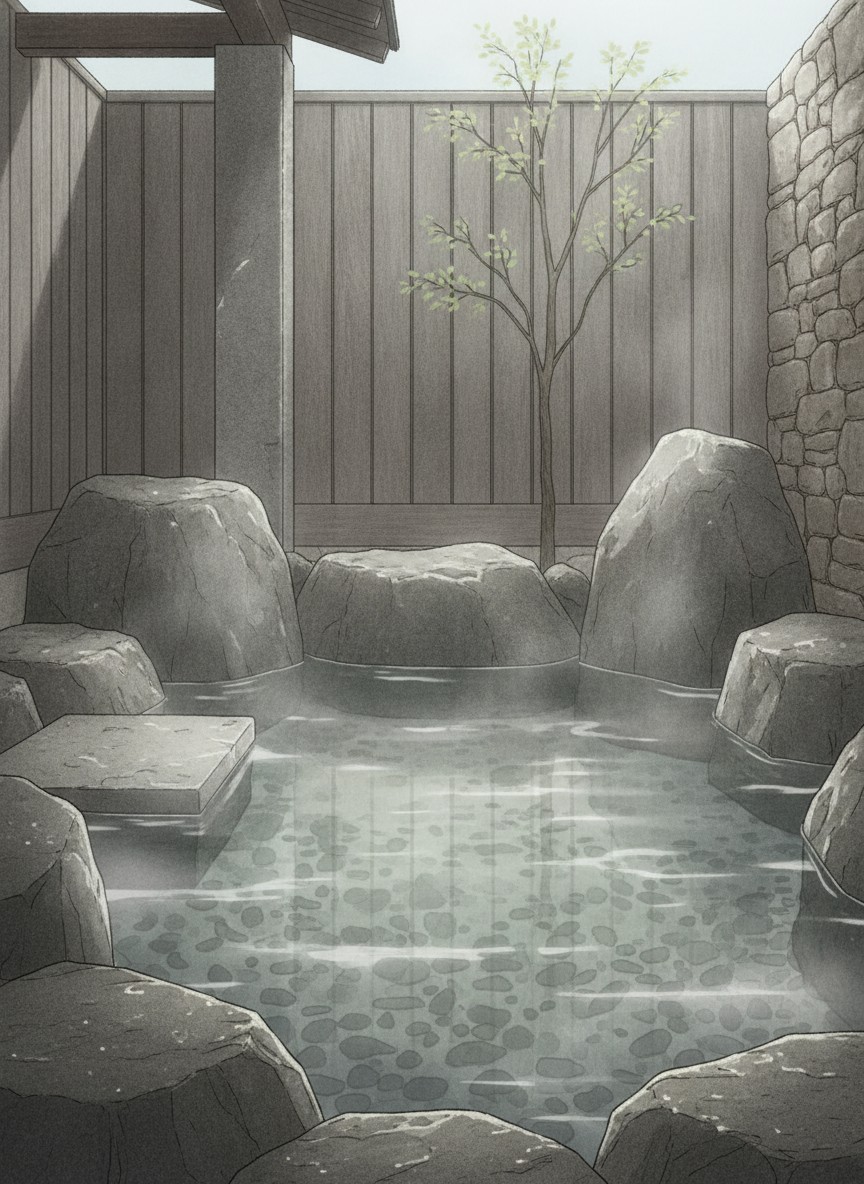
The bath
The water is an alkaline simple sulfur spring from the inn's own source, and every bath on the property runs on it without recirculation. The inn describes a smooth texture that clings to the skin and lists autonomic nerve trouble, insomnia, atopic dermatitis, chronic eczema, lower back pain, frozen shoulder, neuralgia and fatigue among the conditions the water is used for.
The shared baths are the inn's signature. Behind the main bath is a cave bath, dim and steamy, which the inn says works like a natural sauna. The half open-air baths face the bare mountainside: the men's side has a cut-stone basin and a reclining bath looking into a bamboo grove, the women's a large rock bath and a hollowed stone bath hung with bamboo and paper umbrellas. The changing rooms have air conditioning, toilets, washbasins and hair dryers. The inn publishes no bathing hours and takes no day visitors.
The point for a tattooed guest is the room bath. Souan, a Meiji-era building moved from a former Hosokawa clan estate, has a cypress indoor bath and an open-air bath big enough for four or five. Momiji pairs a cypress tub with an open-air bath; Kame has an indoor bath and a chiseled-stone open-air bath; Nousagi has a carved single-stone indoor bath and no open-air tub. The four standard rooms, Ryu, Tsuru, Hoo and Shishi, each have a stone indoor bath and a small open-air bath, in a row-house block where rooms share a wall. All of them are filled from the source.
The hotel
Eight rooms, all detached or semi-detached, each laid out as two or three rooms with a hearth room or a twin bedroom. The front desk is a relocated old sake brewery with a fireplace, and a corridor of stained glass links the buildings. Dinner is a seasonal kaiseki (a multi-course Japanese meal) with Kumamoto country dishes, served in the dining room at 6 or 6:30 p.m.; breakfast is a Japanese set built around Kikuka rice at 8 or 8:30 a.m. The chef changes the menu for returning guests. Free Wi-Fi, yukata (a light cotton robe) and dryers in every room.
Good to know
- Every room has its own spring bath, and only Nousagi lacks an open-air tub.
- Souan's open-air bath seats four or five, the largest private tub on the property.
- Ask about pickup when you book: the inn can sometimes meet guests at the Hirayama Onsen Kanko Kyokai-mae bus stop.
- No day visitors, so the cave bath and the half open-air baths belong to staying guests.
Getting there
From Shin-Tamana Station take the Kyushu Sanko bus to Yamaga bus center, about 50 minutes, then the bus toward Nankan for about 10 minutes to the Hirayama Onsen Kanko Kyokai-mae stop. The inn puts the walk from there at about 15 minutes, and may collect booked guests at the stop if asked. By car it is about 70 minutes from Fukuoka on the Kyushu Expressway to the Nankan interchange, then 20 minutes.
Shin-Tamana STN · Kyushu Shinkansen, then Kyushu Sanko buses via Yamaga bus center
About 15 minutes from the Hirayama Onsen Kanko Kyokai-mae bus stop, by the inn's count.
Pickup from the bus stop can sometimes be arranged when booking.
Where it is

Yamaga Onsen bus stop
- Kyushu Shinkansen 40 min
- Sanko bus 50 min
- Shinkansen tickets Seats between any two stations, booked by date.
- JR Kyushu Rail Pass from ¥12,000 · 3, 5 or 7 consecutive days Worth it if Yamaga is one stop in a longer Kyushu trip by train.
- Kyushu SunQ Pass Worth it if you’d rather ride buses. It covers the Sanko buses from Shin-Tamana and Kumamoto to Yamaga and highway buses across the island.
- Japan Rail Pass from ¥53,000 · 7, 14 or 21 days For a trip that takes in several regions by Shinkansen and JR lines.
What happens when you arrive
Use the bath in your room.
How we know
Bath layout confirmed, tattoo policy not published Checked on the official site: (the rooms page lists each room’s bath; the hot spring page covers the shared baths)
Best for: a couple who wants a relocated Meiji-era suite with a cypress indoor bath and a boulder-rimmed open-air tub of its own
Souan, a relocated Meiji building, has a cypress indoor bath and an open-air bath that seats four or five; Momiji has a cypress tub and an open-air bath; Kame an indoor bath and a chiseled-stone open-air bath; Nousagi a carved single-stone indoor bath and no open-air tub; the four standard rooms Ryu, Tsuru, Hoo and Shishi a stone indoor bath and a small open-air bath each, in a row-house block. All of them run on the inn’s own alkaline simple sulfur source without recirculation. The shared side is a cave bath behind the main bath and men’s and women’s half open-air baths. The inn gives no bathing hours for the room tubs and sells no day use.
Book your stay
- AAgodaCheck availability
- TTrip.comCheck availability
- EExpediaCheck availability
- HHotels.comCheck availability
Booking through these links costs you nothing extra and earns us a small commission, which keeps this guide free and up to date for our tattoo community. Thanks for your support.