
Yoshino Ryokan
人吉温泉 芳野旅館
Does Yoshino Ryokan allow tattoos? In a private bath
Yoshino opened in 1909 as a restaurant and still bathes guests in a garden of cherry and maple, where three tiny open-air tubs are taken one party at a time.
Yoshino publishes no tattoo rule. It has four private baths, the three small open-air Hanare-no-yu tubs in the garden and Yamasemi-no-yu in the main building with an indoor and an open-air tub, and one room, Kinmokusei, has its own spring bath, so a tattooed guest can bathe alone without the men's and women's large baths.
The bath
The water is a sodium chloride and bicarbonate spring, hypotonic, weakly alkaline and hot, 54°C at the source and run at 42 to 44°C indoors and 40 to 42°C in the open-air tubs. It is colorless and soft, and the inn says guests come out with skin that feels moist. It lists the spring for stomach complaints, neuralgia, rheumatism, women's complaints, skin disease and atopic dermatitis. The large bath in the main building has a men's hall and a women's hall; the page gives no hours and no day use.
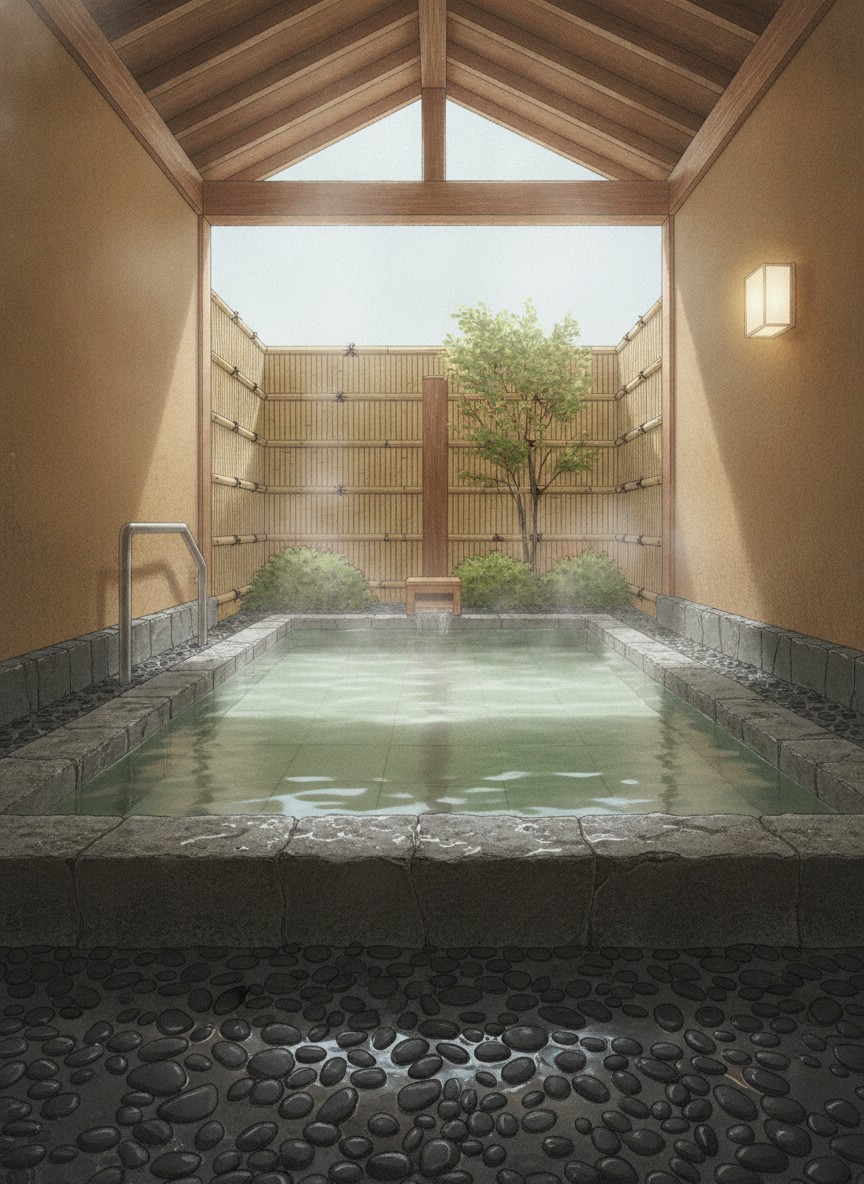
The private baths are the reason to come. Hanare-no-yu, the detached bath, is three small open-air tubs in the garden, Ichi-no-yu, Ni-no-yu and San-no-yu, each a rectangular stone basin set in a bed of dark pebbles under a timber roof, walled by bamboo fencing with the garden planted behind it; the inn says they are small, and that cherry blossom in spring and maples in autumn hang over them. Yamasemi-no-yu in the main building is a fourth private bath with an indoor tub, stone-walled with a window, and an open-air tub. The inn says reserve them for a private soak but publishes no fee, no slot length and no booking method, so ask at check-in.
One room has its own bath: Kinmokusei, a six-mat room with a Western bedroom, is the only guest room with hot spring water, kept at a set temperature.
The hotel
Yoshino opened in 1909 as a restaurant and became an inn, and its wooden buildings and courtyard garden, laid out by a Kyoto gardener in the taste of Hitoyoshi's samurai town, are a registered tangible cultural property. Fifteen rooms are each different: Tsuru, a ten-mat room the inn calls its most popular, with cherry blossom in spring; Matsu, a Japanese-Western room with a shower; Kiku, two eight-mat rooms with old wooden frames and lattice windows; Kinmokusei with its own spring bath; and Satsuki with two semi-double beds. Dinner is seasonal kaiseki (a multi-course Japanese meal) from local ingredients. Check-in 3 to 10 p.m., by 7 p.m. with dinner; check-out 10 a.m.
Good to know
- Four private baths and no posted fee; ask at check-in which is free when.
- Kinmokusei is the one room with a spring bath, a six-mat room with a Western bedroom.
- Hitoyoshi IC is 20 minutes on foot, or 5 by taxi, by the inn's count.
- Free parking for about 20 cars, first come, first served.
Getting there
From Kumamoto Sakuramachi bus terminal take the Sanko highway bus down the Kyushu Expressway to Hitoyoshi, about 1 hour 50 minutes by the city's count. The inn's own route from Hakata is the Shinkansen to Shin-Yatsushiro (about 50 minutes), the B&S Miyazaki bus to the Hitoyoshi IC stop (about 40 minutes), then a taxi of about 5 minutes; from the Hitoyoshi IC stop it also gives 10 minutes by bus or 20 on foot. The inn stands beside Aoi Aso Shrine and publishes no walking time from Hitoyoshi Station.
Hitoyoshi STN · Sanko highway bus from Kumamoto Sakuramachi; B&S Miyazaki bus from Shin-Yatsushiro to Hitoyoshi IC
The inn publishes no walking time from the station; 20 minutes from the Hitoyoshi IC stop.
Taxi 5 minutes from the Hitoyoshi IC stop; free parking for about 20 cars.
Where it is

Hitoyoshi Sanko bus stop
- Kyushu Shinkansen 40 min
- highway bus 1 hr 50 min
- Shinkansen tickets Seats between any two stations, booked by date.
- JR Kyushu Rail Pass from ¥12,000 · 3, 5 or 7 consecutive days Worth it only if the rest of the trip is by train.
- Kyushu SunQ Pass Hitoyoshi’s railway has been cut since the 2020 floods, so the way in is the highway bus from Kumamoto. Worth it if you’re riding buses elsewhere in Kyushu too; it covers that bus and the island’s highway lines.
- Japan Rail Pass from ¥53,000 · 7, 14 or 21 days For a trip that takes in several regions by Shinkansen and JR lines.
What happens when you arrive
Skip the shared baths and use one of the private baths. No reservation needed.
How we know
Bath layout confirmed, tattoo policy not published Checked on the official site (: the hot spring page lists the private open-air baths Ichi, Ni and San-no-yu and the private bath Yamasemi-no-yu)
Best for: a 1909 garden inn where the private open-air tubs sit under cherry and maple
Private baths: Hanare-no-yu Ichi-no-yu, Ni-no-yu and San-no-yu, three small open-air stone tubs in the garden, and Yamasemi-no-yu in the main building with an indoor tub and an open-air tub. The page gives no fee, hours or booking method. The room Kinmokusei (a 6-mat room with a Western bedroom) is the one room with its own spring bath, temperature-controlled. Spring 54°C at source, 42 to 44°C indoors, 40 to 42°C outdoors. Founded 1909 as a restaurant; 15 rooms, each different; registered tangible cultural property. Check-in 3 to 10 p.m. (by 7 p.m. with dinner), check-out 10 a.m. Free parking for about 20 cars.
Book your stay
- AAgodaCheck availability
- TTrip.comCheck availability
- EExpediaCheck availability
- HHotels.comCheck availability
Booking through these links costs you nothing extra and earns us a small commission, which keeps this guide free and up to date for our tattoo community. Thanks for your support.