
Your first onsen visit with tattoos
Most of what goes wrong on a first onsen visit goes wrong before you leave the hotel. The bath itself is simple. Choosing a bath that will let you in, and knowing what the staff will and won’t say, is the part nobody explains. This page walks through a visit from the booking to the drink afterward, with the tattoo questions answered where they come up.
Before you book: find out which of the three rules applies
Every bath in Japan treats a tattoo in one of three ways, and which one depends on the property, not on you.
Allowed outright. Nothing to cover, nothing to declare. 125 of the places in this guide are in this group, and many of them changed their rule recently. Mitsui Garden dropped it at every hotel it runs with a bath on March 1, 2026; Hakone Yuryo and its sister bathhouse in Gotemba dropped theirs on April 1, 2025; and Beppu’s city-run baths are marked tattoo-OK on the city’s own list.
Allowed under a cover seal. A seal is a flesh-colored waterproof patch. 252 places accept one, but only up to a size they set, and the size is the whole question. Common allowances run from one 8 × 10 cm patch (3.1 × 3.9 in) at small independents to two 11 × 20 cm patches (4.3 × 7.9 in) at the Manyo Club bathhouses. APA gives staying guests two 10 × 12 cm seals a night, free at the desk. A forearm piece passes at some of these and fails at others.
Refused in the shared bath. 175 places we checked say so in writing. At these, the only route is a private bath, covered below.
So the first step is to measure the tattoo in centimeters, then read the listing for the place you have in mind. If the listing says “under a seal” and the allowance covers your tattoo, you’re fine. If it doesn’t, a seal won’t get you in, and arguing at the desk won’t either.
What to pack
- Cover seals, if you’ll need them. Buy them before you travel, or order from Amazon Japan, which delivers to hotels. They’re sold in sizes up to a full A4 sheet. The colors are made for light to medium skin; on darker skin the patch shows as a patch. That still satisfies the rule, which is about covering the ink, not hiding the cover.
- A small towel. Hotels and ryokan supply them. Public bathhouses and sento often sell or rent one for ¥100 to ¥300.
- Nothing to swim in. Baths are taken naked. The only exceptions are the swimsuit zones at a few resort spas, which this guide lists separately.
- Coins. Neighborhood sento take cash, and the lockers at some of them want a ¥100 coin, which you get back.
Leave jewelry in the room. Silver tarnishes in sulfur water within minutes.
At the door
Shoes come off at the entrance and go into a locker or onto a rack. Pay at the desk or at a ticket machine. A sento’s price is capped by each prefecture, ¥600 in Tokyo and a little less in most other places; a resort bathhouse costs ¥1,000 to ¥3,000; and a hotel bath is usually included in the room rate.
Do you mention the tattoo? If the place allows tattoos outright, no. If it requires a seal, put the seal on before you go in, and nobody will ask. If you’re unsure of the rule, the honest way is to ask at the desk. Where the operator has published a rule, the listing here quotes it in Japanese, so open the listing on your phone and show the quote; that ends the conversation faster than any phrase you could learn. Where the operator publishes no rule, the listing says so, and asking is the only way to know.
A few operators ask you to declare a tattoo and sign in. Sugoi Sauna in Sapporo, for instance, admits tattooed guests once they’ve declared it and registered as a member, which is free. The listing says where this applies.
The changing room
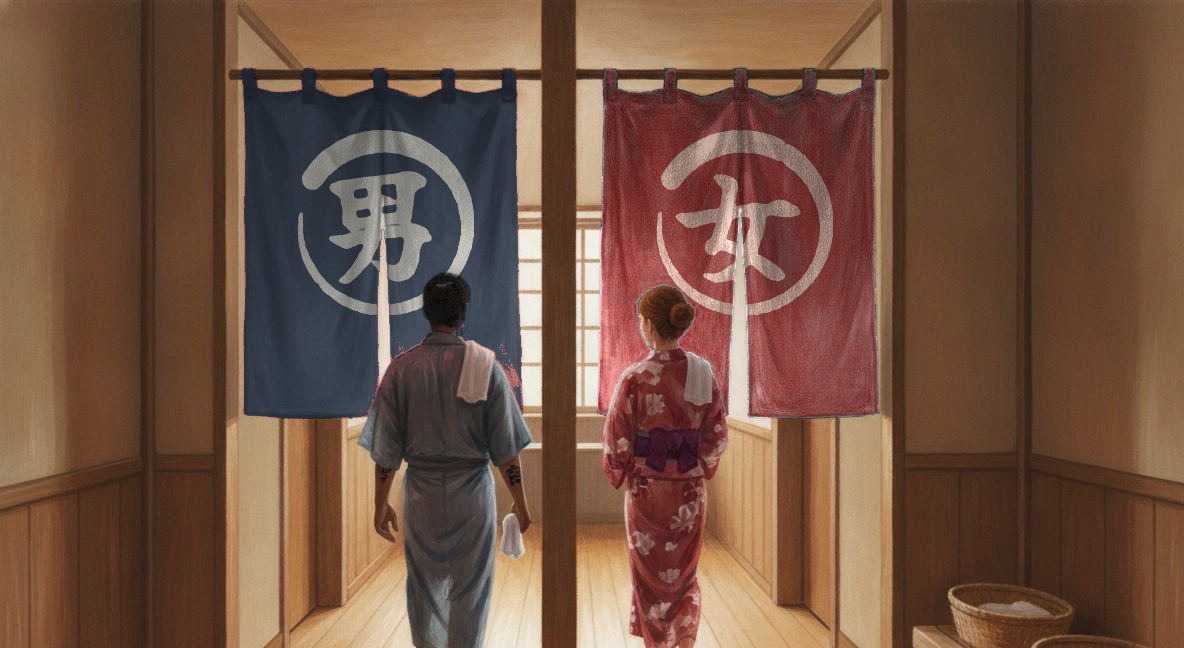
The men’s and women’s entrances are marked by curtains, usually red for women and blue for men, with the characters 女 (woman) and 男 (man) on them. Some baths swap the two sides daily or overnight, so check the curtain, not your memory.
Undress fully and put everything in the basket or locker. The small towel comes with you; the large one stays. So does your phone: photography past the curtain is forbidden at virtually every bath in Japan, and staff enforce it.
Washing
Every bath has a row of low stools and handheld showers along the wall. Sit, wash completely with soap, and rinse until no suds are left, all before you touch the tub. This is the rule Japanese bathers care about most, far more than tattoos. Rinse the stool when you’re done.
If you’re wearing seals, check the edges here. Hot water and soap lift a badly applied patch, and every seal-accepting bath has the same rule: ink showing past the edge counts as uncovered.
In the water
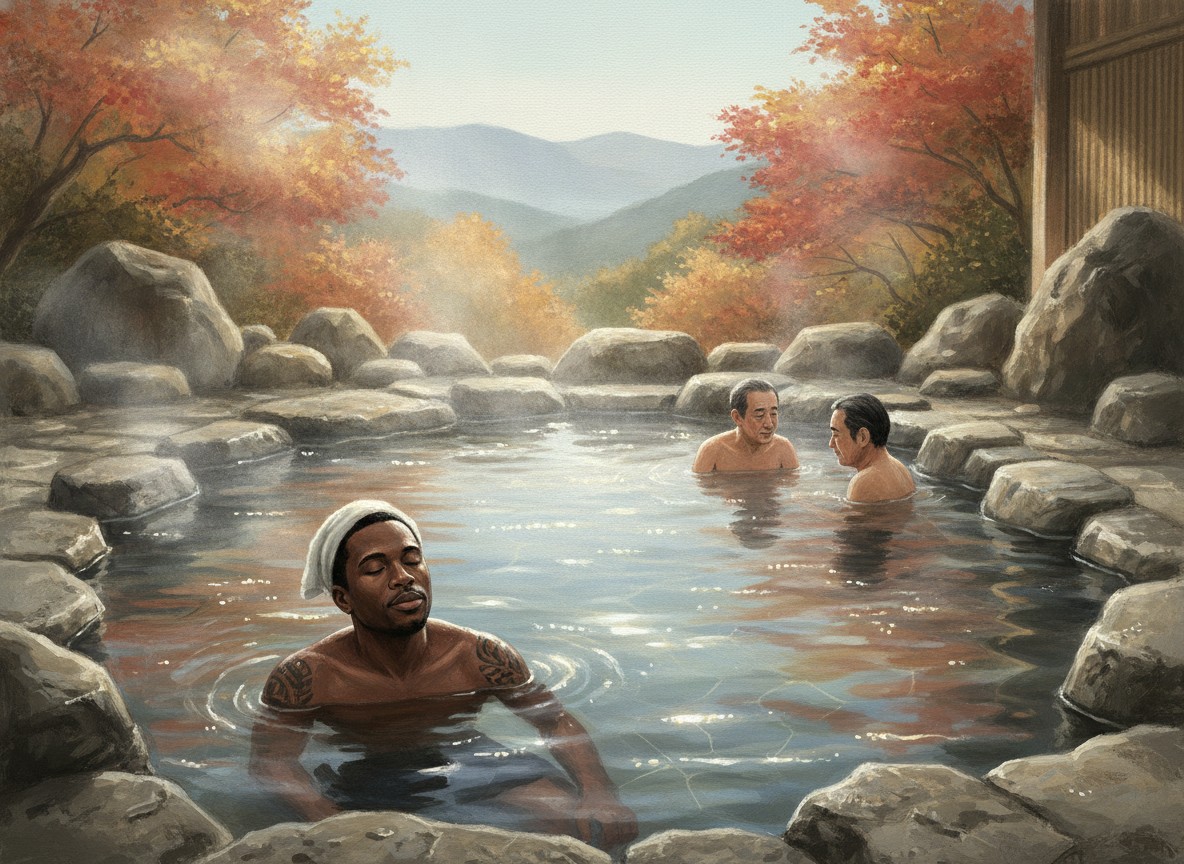
Onsen water runs hot: 40 to 43 °C (104 to 109 °F) in most tubs, and hotter in a few famous ones. Kusatsu’s Ohtaki-no-yu lines up wooden tubs at rising temperatures so you can work up to the heat. Ease in, stay ten minutes, get out, cool off, go back. Nobody is timing you, but three short soaks are better than one long one, and first-timers who stay in for half an hour feel it for the rest of the day.
The small towel never goes in the water. Fold it and put it on your head or on the rim.
Talk quietly, don’t swim, and keep your hair out of the water. The same rules hold in a rotenburo, the open-air bath, where the view is the point.
Fresh tattoos don’t soak. A tattoo in its first weeks is still a healing wound. Hot mineral water, especially acidic water like Kusatsu’s or Tamagawa’s, can fade it and infect it. Wait until it’s fully healed, which for most pieces means about four weeks and for large work longer.
Saunas and cold plunges
Many baths have a sauna with a cold tub beside it. The cold tub is for after the sauna, and you rinse off the sweat before you get in. Sauna etiquette follows the bath: sit on your towel, keep quiet where it’s a quiet sauna, and leave when you want to.
The tattoo rule inside the sauna is the same as in the bath. A few sauna-only places have gone further than most onsen: SaunaLab in Nagoya and A-SAUNA in Sapporo admit tattoos without restriction, and A-SAUNA gives you the room to yourself for your booking.
After the bath
Most bathers skip a final rinse after a mineral bath, to leave the minerals on the skin. At strongly acidic springs such as Kusatsu and Zao, or if your skin is sensitive, rinse.
Dry off in the wet area before you step back onto the changing-room mats.
The rest is up to you. A bottle of cold milk or coffee milk from the vending machine is the traditional finish, and at a ryokan most guests take their first bath before dinner.
If you’re turned away
It happens, and it isn’t personal. The person at the desk didn’t write the rule and usually can’t bend it. What to do:
- Ask whether there’s a kashikiri, a private bath you can reserve by the hour. Many places that refuse tattoos in the shared bath rent one.
- If not, ask whether a seal would be accepted, and what size. Some places that say no on the sign say yes to a covered tattoo.
- If the answer is still no, leave politely. There’s no appeal, and a scene costs you more than it costs them.
- Open this guide and find the nearest bath that allows tattoos. In Beppu and Kinosaki there’s one within walking distance of almost anywhere in town, and Tokyo has dozens.
A refusal at one bath says nothing about the next. The same chain can allow tattoos in one town and refuse them in another, and the listing for each place says which.
Are you onsen-shy?
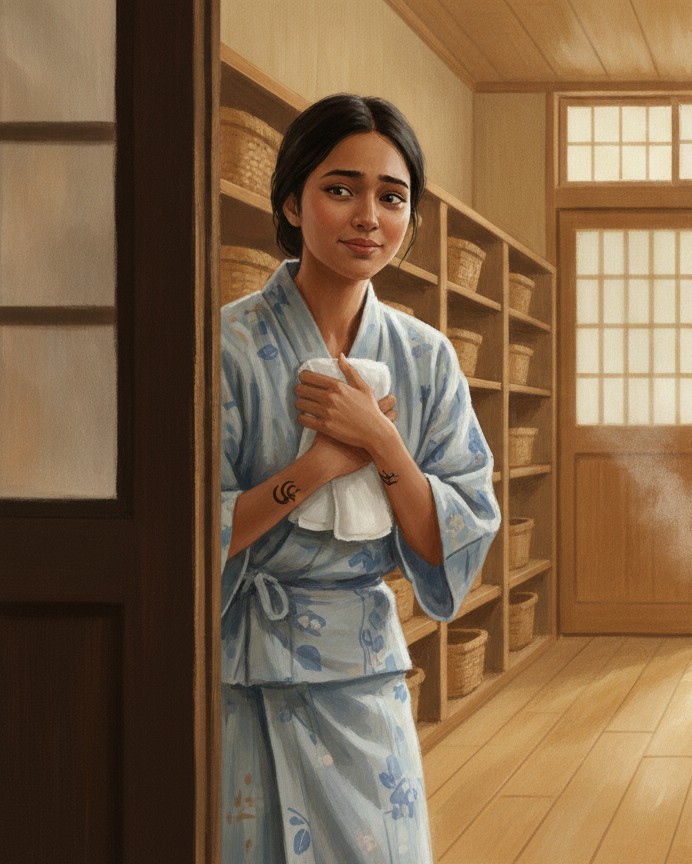
Most first-timers are. Bathing naked among strangers isn’t something most visitors grew up with, and a tattoo adds the worry of being stared at. So people book a room with its own tub, or a 40-minute private slot, and never set foot in the large bath, the daiyokujo, even at inns where tattoos are welcome there.
We’d nudge you the other way. Where tattoos are allowed, take the daiyokujo.
- It’s the bath the inn was built around. A daiyokujo is a room, not a tub: two or three baths at different temperatures, a row of taps along one wall, and often a door to the open-air bath (rotenburo), where the ceiling is the sky and the steam goes straight up into cold air. The biggest tub, the view and the water straight from the source are all here. The private bath is usually a smaller room down the hall.
- There’s no clock. A private slot is 40 to 60 minutes, once an evening. The large bath is open from mid-afternoon until late and again from early morning, and many inns swap the men’s and women’s sides overnight so you get to try both.
- It costs nothing extra. A private bath often does.
- It asks nothing of your Japanese. A restaurant needs vocabulary and a shrine needs explaining. A bath needs you to do the same few things as everyone else in the room, in the same order, and nobody minds a step done slightly wrong.
- Nobody is staring. The people around you have bathed this way since childhood. At a bath that allows tattoos, a passing glance is the most you’ll get, and after ten minutes in the water you’ll stop thinking about it. Remember, you will never see these people again.
- It’s the onsen. Sharing the water is the custom, and it’s what onsen towns are built around. A tub in your room is a very good bath; it isn’t the same thing.
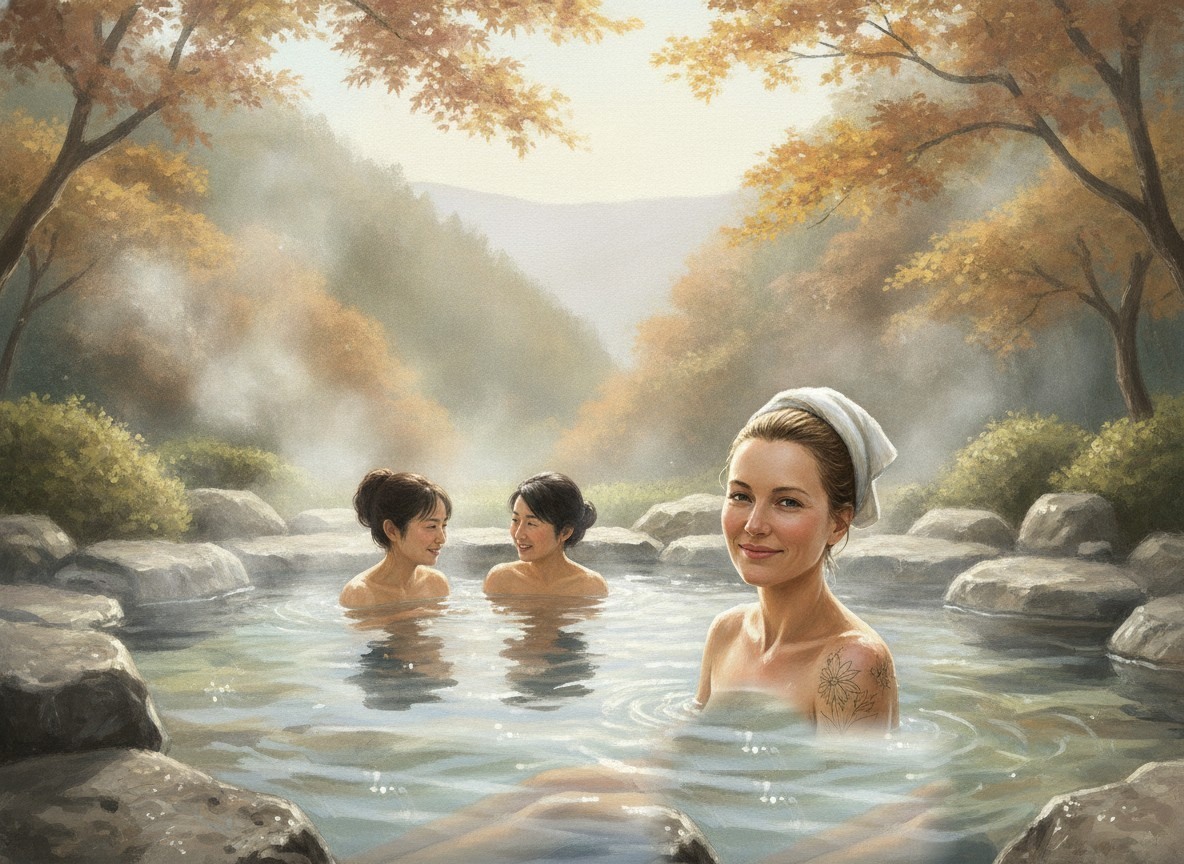
To ease in, go at a quiet hour: after 10 at night, or around 6 in the morning, when you may have the bath to yourself. At a hotel without set meal times, the dinner hour is quiet too. Wash first, carry the small towel in front of you as everyone does (and keep it out of the water), and settle in near the steps. The second visit is easy.
Private baths: for when the large bath says no
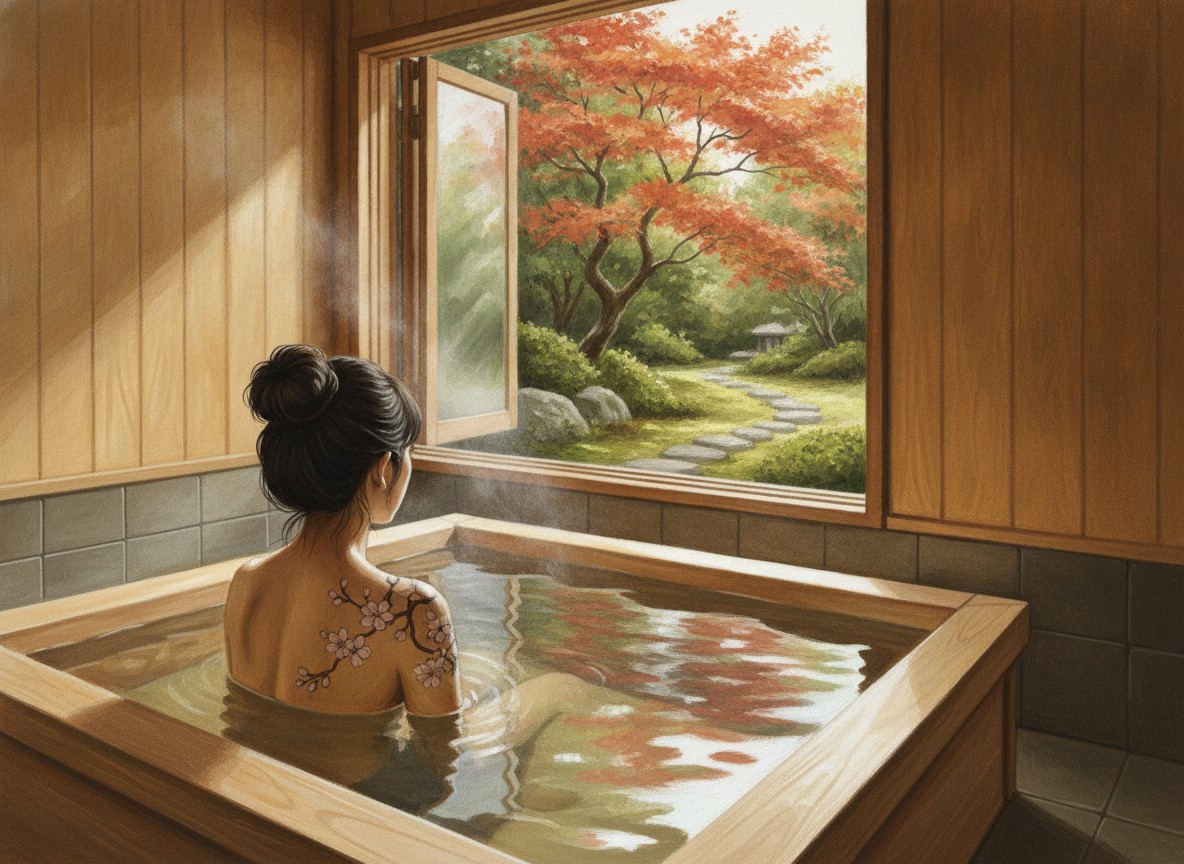
A kashikiri (sometimes “family bath”) is a bath you reserve for your own use, usually for 40 to 60 minutes. An in-room bath is the same thing without a clock. Either way you aren’t sharing water with anyone, so the rule written for the shared bath doesn’t apply. It’s the answer when the large bath refuses tattoos, when yours is bigger than the seal the bath allows, or when you want to bathe together as a couple or a family.
880 listings in this guide have one. Most of these inns lend it free to staying guests, reserved at check-in or booked with the room. Where there’s a charge it’s usually ¥2,000 to ¥3,300 for 45 or 50 minutes. Some inns also rent to day visitors. The full picture is in the private onsen guide.
One caution: a private bath makes the shared-bath rule moot, but a small number of properties in Japan refuse tattooed guests from the premises entirely. Our listings flag any property whose written rule is phrased that way.
Mixed baths, children and the rest
- Mixed bathing survives at a few old mountain baths, usually with a bathing wrap sold or rented at the desk. The guide marks them.
- Children can go in with either parent up to about age six; after that, local rules split them by sex.
- Periods: most Japanese women skip the bath during their period. Tampons are tolerated but not the custom.
- Drinking: bathe before you drink, not after. Alcohol and 42 °C water are a common cause of the ambulance calls in onsen towns.
Onsen or sento?
An onsen uses natural hot spring water, which Japanese law defines by temperature or mineral content. A sento is a neighborhood bathhouse, usually heated tap water, with a legally capped price. The etiquette is identical. The tattoo rules differ: sento have generally been looser, and a city sento is the easiest first bath for a tattooed visitor almost anywhere in Japan.
Questions people ask before their first visit
Do I have to be naked?
Yes, in any standard onsen or sento. The only places that allow swimwear are resort spa zones built for it, which this guide lists under swimwear areas.
Will people stare at my tattoo?
Less than you expect. At a bath that allows tattoos, the other bathers have seen them before. A glance is normal; comments are rare.
Can I cover a tattoo with a bandage or plaster instead of a seal?
Bandages come off in hot water, and most baths that accept a seal name the seal specifically. Bring the real thing.
How long should a first soak be?
Ten minutes, then out. Three ten-minute soaks with rests between beat one of thirty.
Is it rude to wear seals?
No. Seals exist because operators asked for them, and a bath that accepts them has decided they’re the courteous option.
My tattoo is a month old. Can I go?
If it’s fully healed, with no scabbing or peeling, yes. If not, wait. Mineral water and a healing tattoo are a bad pair, for the tattoo and for the other bathers.
I’m onsen-shy. Should I just book a private bath?
If the large bath allows your tattoo, try it once at a quiet hour before you decide. It’s the better bath, it’s included in your stay, and for most people the shyness lasts about ten minutes.
Where should I go first?
A bath that allows tattoos outright, so the only thing to think about is the bath. Beppu, Kinosaki, Hakuba and Tokyo each have several, and the towns guide ranks them.
More guides
Onsen towns that welcome tattoos, ranked by their own rules →
Private onsen in Japan: kashikiri, family baths and in-room tubs →
Tattoo cover seals for onsen: where to buy them in Japan, and what size you need →