
Private onsen in Japan: kashikiri, family baths and in-room tubs
A private onsen is the one answer that works for almost every tattoo, at every size, in every town. You aren’t sharing the water, so the rule written for the shared bath has nothing to apply to. 880 of the listings in this guide have one. This page explains the three kinds, what they cost, how booking works, and where to find the most of them.
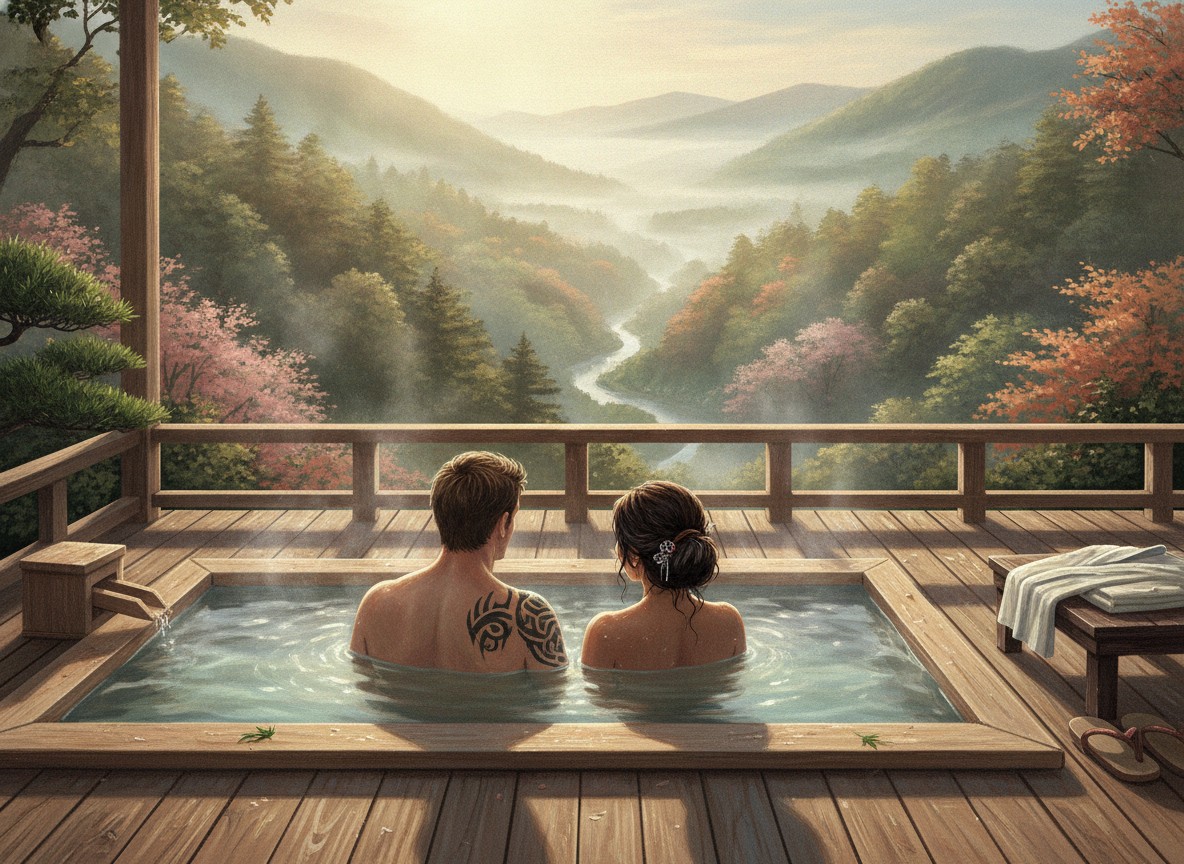
First: are you onsen-shy?
If the inn’s large bath, the daiyokujo, admits your tattoo, use it. It’s the bigger bath with the better view, it has no time limit, and it’s included in the room rate. Plenty of visitors book a private bath only because bathing among strangers feels daunting, and most find the feeling gone within ten minutes of getting in. The first-visit guide has a section on exactly that.
A private bath is the right choice when the large bath refuses tattoos, when your tattoo is bigger than the seal it allows, or when you want to bathe together as a couple or a family. The rest of this page is for those cases.
The three kinds
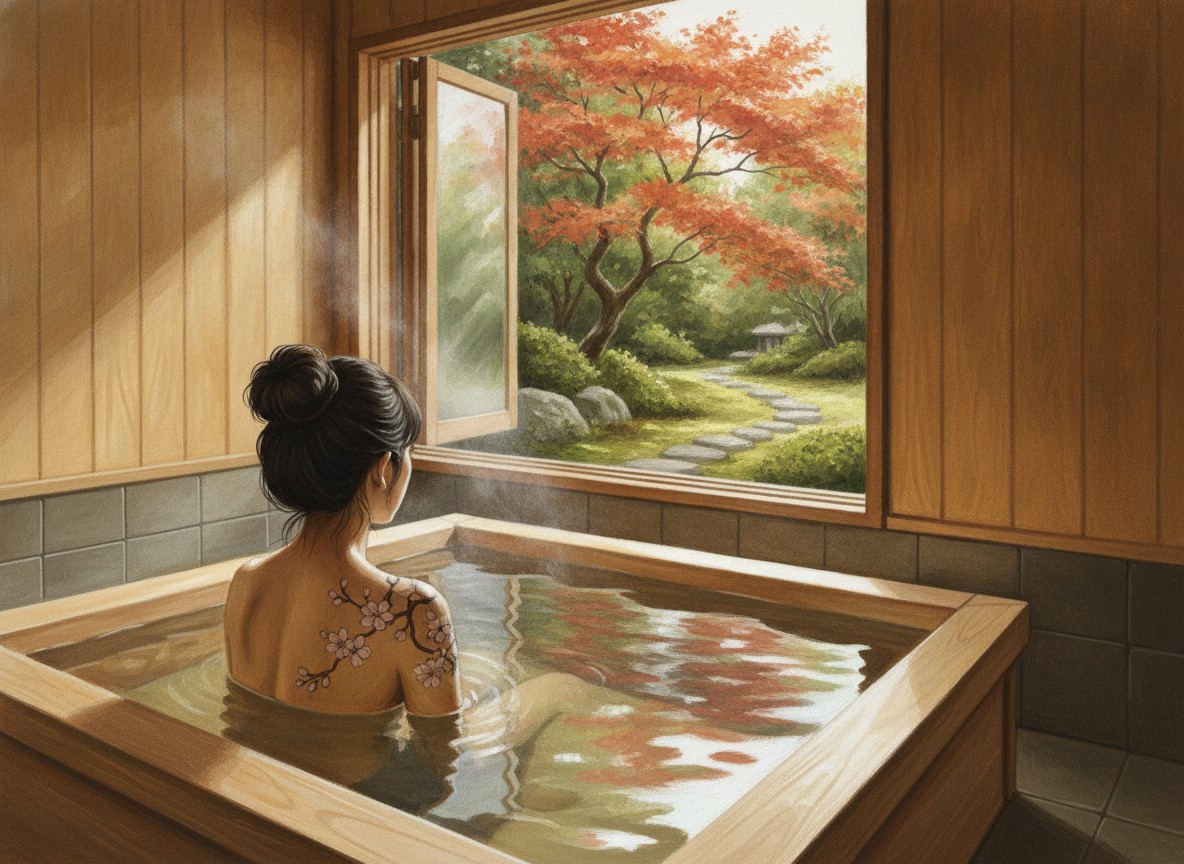
Kashikiri-buro: a bath you reserve. The word means “reserved for exclusive use.” The inn sets aside one or more baths for private use; you book a slot, usually 40 to 60 minutes, lock the door, and the bath is yours. Many inns call it a family bath, kazoku-buro, because couples and families with children are the usual users. Some have an open-air kashikiri with a view that beats the main bath.
In-room baths. A room with its own tub, fed by the spring, on a terrace or by the window. No clock, no booking, and the water is yours for the stay. Inns describe these as rooms “with open-air bath,” and the room price reflects it. About 460 About 400 of the listings here have rooms of this kind.
Day-use rentals. A smaller number of inns, and a few bathhouses, rent a private bath by the hour to people who aren’t staying. This is how a tattooed visitor bathes in a town like Arima, whose public baths refuse, without booking a night.
What it costs
Free is the normal price. 709 of the private-bath listings here say the bath is free to staying guests, included in the room rate or lent at no charge: you reserve a slot at check-in, or the inn assigns one. Jukeiso on Miyajima lends its open-air view bath for 30 minutes, reserved at check-in in order of arrival. Miyajima Hotel Makoto lends its indoor bath for 40 minutes at 5, 8 or 10 p.m., three groups a night, booked ahead.
Where there’s a charge, the going rate is ¥2,000 to ¥3,300 for 45 or 50 minutes, and the most common price in our data is ¥3,300 for 50 minutes. The range runs from ¥1,500 at inns such as Atami Sekitei and Yuraku in Awara to ¥5,500 for 50 minutes at Umi no Hotel Shimahana on Awaji, where the bath is the attraction.
Day-use rentals cost more, often with a bath fee on top. Aki Grand Hotel, across the water from Miyajima, rents its open-air bath for ¥3,800 for 45 minutes for up to six people, and Miyahama Grand Hotel rents its bath Momiji for ¥3,800 plus the ¥800 bath fee.
In-room baths aren’t priced separately. The room is.
How booking works, and where it goes wrong
Booking rules vary more than prices do, and each inn’s listing gives its rule. The patterns:
- Reserved at check-in, first come, first served. The most common arrangement. Arrive early. Jukeiso warns on its own page that late arrivals in busy periods may miss the bath, and that’s true of every inn with this rule.
- Booked with the room. Some inns, Makoto among them, take the bath reservation when you book, and slots go in booking order. Ask for one in the booking’s message field.
- Assigned. A few inns give each room a slot. You get what you’re given, and it’s usually fine.
- Walk-up. Where there are several baths and few guests, you check a board by the baths, see which is free, turn the sign to “in use,” and go in.
Slots are short. Forty minutes is enough for a bath; it isn’t enough for a bath, a photo session and a second bath. Wash before you get in, as in any bath: the next group uses the same water.
The tattoo rule in a private bath
Operators’ rules are written for the shared bath. In a private bath there’s no one to object and no one to protect, and no operator’s page we’ve read refuses a tattooed guest the private bath it rents.
Two cautions, both from the data:
- A property can refuse tattooed guests from the premises, not just the bath. The rule exists in Japan, usually written as “guests with tattoos may not stay.” No private-bath listing in this guide carries it today, and if one does, the listing will say so. LiVEMAX Resort Aki Miyajima is a different case: its shared baths refuse tattoos in writing, stickers and paint included, but all 50 rooms have a hot-spring tub on the terrace, and the written rule doesn’t mention the rooms. The listing says exactly that and leaves the judgment to you.
- At an inn whose shared baths refuse tattoos, be discreet. Walk to the private bath in the yukata the inn gives you. Nobody is checking, but the inn’s rule is the inn’s rule.
What a private bath doesn’t do is get you into the shared bath. If the main bath is the one you want, you need a town where the main baths allow tattoos, and the towns guide ranks those.
Is the water a real spring?
Usually, and the listing says when it isn’t. Japanese law lets an inn call its bath an onsen if the water meets a temperature or mineral threshold at the source; what happens between the source and the tub varies. Some in-room tubs are fed from the inn’s own spring, free-flowing. Some are filled from a tank and reheated. A few use heated tap water or an artificial spring, and inns say so on their own pages: Hotel Kikunoya on Miyajima describes the water in its annex tubs as an artificial hot spring, and our listing notes it.
If the spring matters to you, read the bath paragraph of the listing before you book. “Free-flowing from the source” (gensen kakenagashi) is the phrase inns use when they can.
Where the private baths are
Ranked by the number of listed inns with a private bath:
| Town | Inns with a private bath | Shared baths allowing tattoos outright |
|---|---|---|
| Kuju and Nagayu | 38 | 0 |
| Higashi-Izu | 24 | 0 |
| Arima Onsen | 20 | 0 |
| Yudanaka and Shibu | 20 | 1 |
| Kinugawa Onsen | 19 | 1 |
| Unzen and Obama | 19 | 0 |
| Shirahama | 18 | 0 |
| Matsumoto | 17 | 1 |
| Nasu Onsen | 17 | 1 |
| Hakone | 16 | 6 |
Kuju is the deepest private-bath town in this guide: 38 inns in a highland of small properties between Yufuin and Aso, many with rooms that come with their own tub. Higashi-Izu is the coastal version, inns down the east side of the Izu peninsula with tubs facing the Pacific. Arima is the case where the private bath is the main route, since no listed shared bath there admits a tattoo without a cover, and its inns know it: several rent by the hour to day visitors. Hakone and Yudanaka combine the two, with open shared baths at some places and private baths at others.
The towns guide and each town’s page give the full list, with the free-or-paid rule and the booking rule for every inn.
Private baths for day visitors
Where an inn rents to non-guests, the listing says so and gives the price. The towns with the most day rentals in our data are in Kyushu: Kirishima and Kuju with eleven each, Kurokawa and Unzen with ten, and Yamaga with nine . Arima and the inns facing Miyajima are the equivalents near Osaka and Hiroshima. Book by phone or on the inn’s site a day ahead; walk-ups get what’s left. Some ask you to bring your own towel, and the listing says which.
Questions people ask about private onsen
Do private onsen allow tattoos?
In practice, yes, everywhere in this guide. The rule is written for the shared bath. The exceptions would be a property that refuses tattooed guests from the building, which no listing here has today and which the listing would flag, and your own discretion at an inn whose shared baths refuse.
How much does a kashikiri cost?
Nothing, at most inns, for staying guests. Where there’s a charge, ¥2,000 to ¥3,300 for 45 to 50 minutes is the norm, and ¥5,500 the top of our data.
Can I use a private onsen without staying the night?
At some inns, yes, for a fee that includes the bath charge. Kirishima, Kuju, Kurokawa and Unzen have the most inns that do it; Arima is the easiest near Osaka.
Can a couple bathe together in a private bath?
Yes. That’s what kashikiri are for. Mixed bathing is otherwise rare in Japan.
Is a room with an open-air bath worth the price?
If you’ll use it more than once a day, yes; a shared kashikiri usually gets you one slot an evening. If one bath is enough, book the cheaper room and use the free kashikiri.
How do I ask for the private bath in Japanese?
“Kashikiri-buro o yoyaku dekimasu ka?” means “Can I reserve the private bath?” At check-in it’s enough to say “kashikiri” and point at the clock.
Does a private bath count as a real onsen?
If the inn’s spring feeds it, yes. The listing’s bath paragraph says where the water comes from, and says plainly when it’s heated tap water or an artificial spring.
More guides
Your first onsen visit with tattoos →
Onsen towns that welcome tattoos, ranked by their own rules →
Tattoo cover seals for onsen: where to buy them in Japan, and what size you need →