
Onsen towns that welcome tattoos, ranked by their own rules
Lists of “tattoo-friendly onsen towns” are usually four famous names and a feeling. This one is a count. For every town in this guide we read each bath’s tattoo rule on the operator’s own page, so we can say how many places in a town admit a tattoo with nothing to cover, how many take a cover seal, and how many offer a private bath instead. Those three numbers, town by town, are what follows.
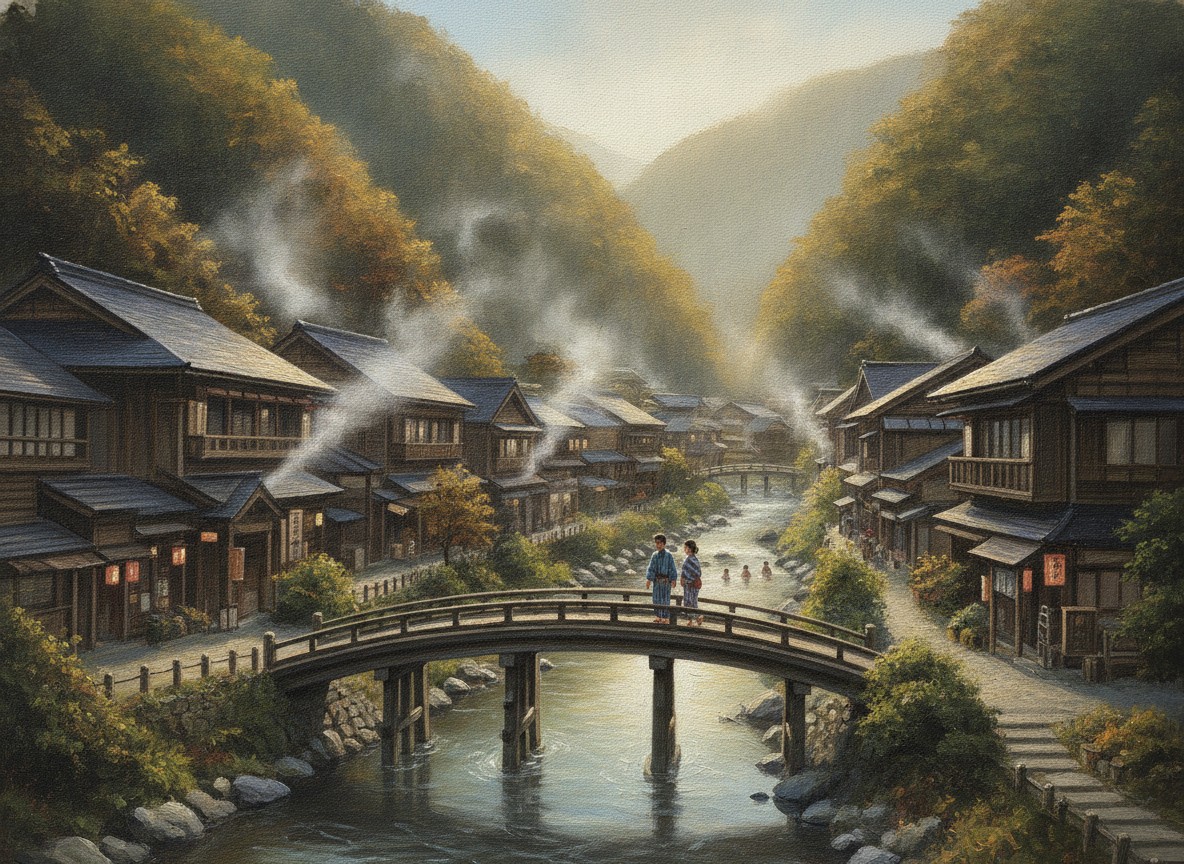
Two things to know before the table. First, “welcomes tattoos” means the shared bath, the one everybody uses. A town with no such bath can still be an easy trip if its inns have private baths, and the second half of this page covers those. Second, the counts are of places we’ve listed, not of every bath in the town. A town with three listed baths that all allow tattoos is a small sample; a town with thirty is a pattern.
Towns where you can bathe with nothing to cover
Ranked by the number of listed places that allow tattoos in the shared bath.
| Town | Allowed outright | Under a seal | Private bath | Listed |
|---|---|---|---|---|
| Beppu Onsen | 19 | 2 | 11 | 32 |
| Tokyo | 19 | 48 | 4 | 71 |
| Kinosaki Onsen | 10 | 0 | 0 | 10 |
| Hakuba | 7 | 1 | 6 | 14 |
| Kyoto | 6 | 8 | 1 | 15 |
| Hakone | 6 | 6 | 16 | 29 |
| Sapporo area | 5 | 5 | 1 | 11 |
| Osaka | 5 | 34 | 0 | 39 |
| Kusatsu Onsen | 4 | 2 | 9 | 15 |
| Nagoya area | 4 | 12 | 0 | 16 |
| Takayama | 4 | 3 | 14 | 21 |
| Akiu Onsen | 3 | 3 | 1 | 7 |
Beppu: the most open town in Japan, and it’s official
Beppu City runs its own bathhouses and publishes which of them accept tattoos. Nineteen listed places here admit a tattoo with nothing to cover, tied with Tokyo for the most of any town, and most are city baths charging a few hundred yen: Takegawara, with its sand bath; Kaimon-ji, with one hot tub and one cooler; Furosen, the largest tub of the city baths; Tano-yu, Nagaishi, Hamawaki and Horita. Eleven more inns offer a private bath. For a first onsen trip with a large tattoo, no other town comes close.
Every Beppu listing, with each place’s rule
Tokyo: nineteen hotel baths, most of them new to the list
Tokyo’s count comes almost entirely from one decision. Mitsui Garden removed its tattoo rule at every hotel it runs with a bath on March 1, 2026, which put Nihonbashi, Ginza, Toyosu, Shiodome and Jingugaien on this list in a single day. Candeo had already removed it at Roppongi. Tokyo also has the most seal-accepting baths of any town, 48, so a traveler whose tattoo a seal can cover has up to 67 places to choose from, depending on the size each one allows. What Tokyo lacks is private baths: four listed.
Every Tokyo listing, with each place’s rule
Kinosaki: every confirmed place says yes
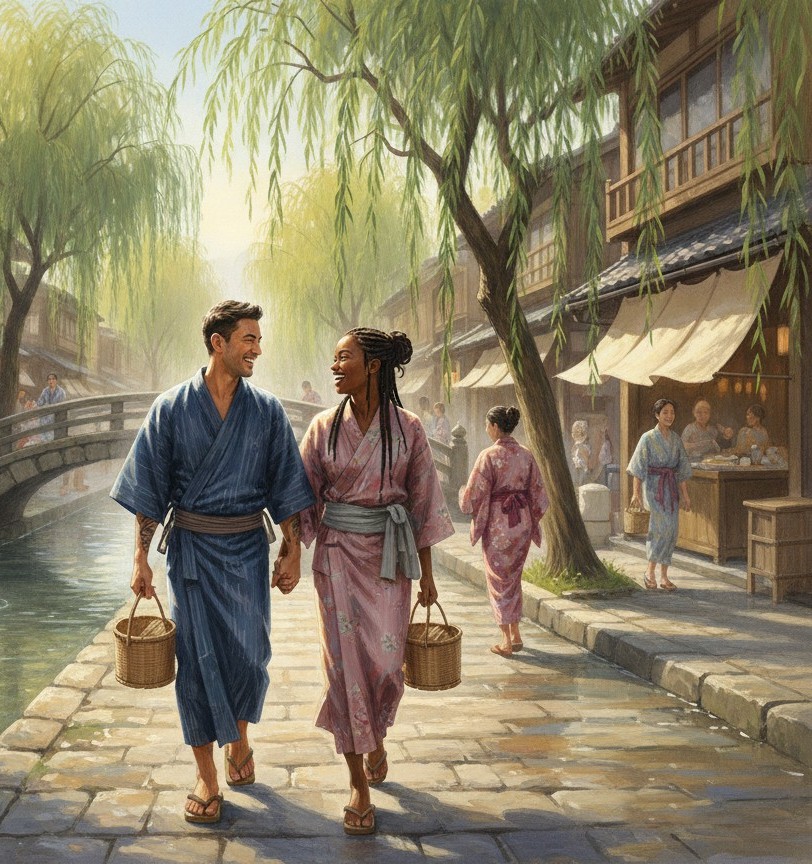
Kinosaki is the one town in this guide where every listed place allows tattoos, and it’s the town where that matters most, because the point of Kinosaki is walking between its seven public bathhouses in a yukata (a light cotton robe). Five of the seven, Ichino-yu, Goshono-yu, Jizo-yu, Yanagi-yu and Mandara-yu, admit tattooed bathers on the operator’s own word. For Kono-yu and Sato-no-yu we found no rule we could confirm, so they aren’t counted. Stay at a ryokan such as Nishimuraya Honkan and the Yumepa pass you get at check-in covers all seven. There’s no seal rule to read and no private bath to book.
Every Kinosaki listing, with each place’s rule
Hakuba: the Happo day baths
Hakuba’s four Happo day baths, Happo-no-yu, Mimizuku-no-yu, Obinata-no-yu and Sato-no-yu, share one rule: tattoos allowed, nothing to cover. Two open only in their season, Obinata in summer and Sato in winter, so check the listing for dates. Hotel Goryukan opens its bath and sauna to day visitors under the same rule. Half of Hakuba’s listed places allow tattoos outright, the highest share of any ski town.
Every Hakuba listing, with each place’s rule
Hakone: a resort town that changed its mind
Hakone used to be the textbook strict resort town. Hakone Yuryo, the big day bathhouse above Hakone-Yumoto, lifted its restriction on April 1, 2025. Yamanochaya and the two Gora Hanaougi ryokan say in their own FAQs that tattoos are welcome in the shared baths, and Hoshino’s KAI Hakone follows the group’s policy of admitting them. Hakone also has sixteen private-bath inns, the most of any town in this table, so 28 of its 29 listed places are open to you one way or another: six with nothing to cover, six under a seal and sixteen with a private bath. The other is a swimsuit spa.
Every Hakone listing, with each place’s rule
Kyoto, Sapporo, Nagoya: the hotel chains carry the cities
In the big cities the open baths are mostly hotel baths, and mostly Mitsui Garden and Candeo. Kyoto has six, including Kurama Onsen in the hills north of the city. Sapporo has five, three of them reservation-only saunas where the room is yours. Nagoya has four, among them Hakusan Onsen, a sento on its own well whose FAQ answers the tattoo question with a flat yes. Osaka is the city to read carefully: only five open baths, but 34 that accept a seal.
Kusatsu and Dogo: the famous baths, by the rule
Two of Japan’s best-known hot springs allow tattoos at their signature baths. In Kusatsu, the three town-run baths, Ohtaki-no-yu, Goza-no-yu and the open-air pools at Sainokawara, have no restriction. In Dogo, all three Dogo Onsen bathhouses admit tattoos: the Honkan, fully reopened in July 2024, the Asuka-no-yu annex and Tsubaki-no-yu. The ryokan around them are stricter, which is why both towns show more private-bath inns than open baths.
Towns where a seal is the route
Tokyo (48 places under a seal), Osaka (34) and Nagoya (12) are the big three. In all of them the number that matters is the size each bath allows, which ranges from one 8 × 10 cm patch to two 11 × 20 cm patches depending on the chain. The cover seal page lists every place by the size it accepts, smallest first.
Towns where the inns have private baths
Twenty-five of the 104 towns in this guide have no listed shared bath that admits a tattoo, covered or not. They aren’t closed to you; they’re private-bath towns, and Kuju and Unzen are two of them. The table ranks every town by its inns with a private bath, with its open and seal counts alongside:
| Town | Inns with a private bath | Allowed outright | Under a seal |
|---|---|---|---|
| Kuju and Nagayu | 38 | 0 | 0 |
| Higashi-Izu | 24 | 0 | 2 |
| Arima Onsen | 20 | 0 | 1 |
| Yudanaka and Shibu | 20 | 1 | 1 |
| Kinugawa Onsen | 19 | 1 | 5 |
| Unzen and Obama | 19 | 0 | 0 |
| Shirahama | 18 | 0 | 4 |
| Matsumoto | 17 | 1 | 1 |
| Nasu Onsen | 17 | 1 | 2 |
| Hakone | 16 | 6 | 6 |
Arima belongs here, not on the “welcomes tattoos” list where other guides often put it. No listed bath in Arima admits a tattoo with nothing to cover, and one takes a cover seal. What Arima has is twenty inns with a private bath, several of which rent it to day visitors for ¥2,200 to ¥4,400 for 40 to 45 minutes, so a tattooed visitor can still bathe in the gold water, in private.
Kuju, with 38 private-bath inns, is the quiet champion of this table: a highland of small inns between Yufuin and Aso, many of them with rooms that come with their own tub.
How to read these numbers
- “Allowed outright” means the operator’s own page says tattoos are admitted to the shared bath with nothing to cover. Where the operator reserves the right to refuse, as Hoshino Resorts does across its KAI inns, the listing says so.
- “Under a seal” means admitted when the tattoo is completely covered, up to a size the operator sets.
- “Private bath” means the inn has a reservable bath or an in-room bath. The shared-bath rule at these inns may be anything, including refusal.
- Places whose rule we couldn’t confirm from the operator aren’t counted anywhere above. There are 482 of them, and their listings say the rule is unconfirmed.
The counts change as operators change their rules, and this page is rebuilt from the listings, so the ranking here is the ranking today.
Questions people ask about tattoo-friendly towns
Which onsen town is best for a large or full-body tattoo?
Beppu. Nineteen baths with no size limit and no seal, most of them a few hundred yen, plus eleven inns with private baths.
Is Kinosaki really all tattoo-friendly?
Every place we could confirm, yes: five of the seven public bathhouses, and the ryokan whose passes cover them. Two bathhouses publish no rule we could check.
What about Kusatsu?
The three town baths allow tattoos. Most ryokan there don’t in their shared baths, and nine offer a private bath instead.
Does Arima welcome tattoos?
Not without a cover. One listed place takes a seal and none allows tattoos outright. Twenty Arima inns have private baths, and several rent them by the hour to day visitors.
Which city is easiest?
Among the big cities, Tokyo: nineteen baths allow tattoos outright and 48 more take a seal. Beppu is smaller, but easier still.
Where should I avoid?
Nowhere, if you’ll take a private bath. Twenty-five towns have no open shared bath, and the table above shows which towns have the most inns with a bath of their own.
More guides
Your first onsen visit with tattoos →
Private onsen in Japan: kashikiri, family baths and in-room tubs →
Tattoo cover seals for onsen: where to buy them in Japan, and what size you need →