
Kurama Onsen
くらま温泉
Does Kurama Onsen allow tattoos? Yes!
A sulfur spring rich in iron, rising in the village at the foot of Mount Kurama, with an open-air bath on a rise apart from the main building that looks across the valley: cedar in summer, maples in autumn.
Nothing to cover. The facility’s own site says so plainly.
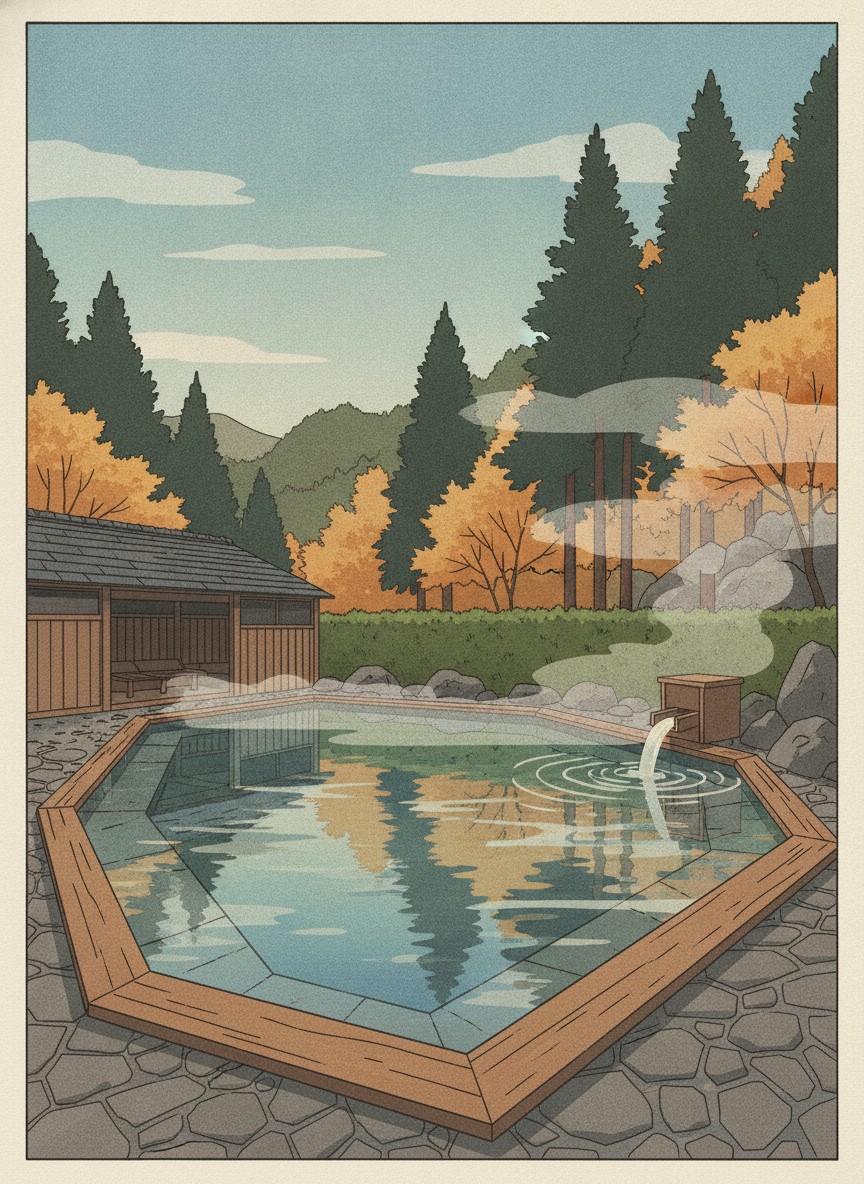
The bath
The water is a sulfur spring, a type the onsen notes is rare in this part of Japan, and heavy in iron. In the onsen’s photos the open-air bath is a wide tub edged in wood on a flagstone terrace, filled from a wooden spout, with cedar and maple crowding in on every side. The men’s and women’s open-air baths are almost identical, and each has a small indoor bath and showers of its own, so the open-air ticket alone makes a complete visit.
The main building has a second pair of baths: a large indoor tub behind a wall of glass onto the green hillside, a sauna, and a cold bath the onsen describes as well chilled, with room wear to change into afterward. Both areas stock shampoo, conditioner, body soap, hair dryers and lockers, and the indoor side adds a water server. Swimsuits aren’t allowed, and towels stay out of the water.
Day use runs 10 a.m. to 9 p.m. The full set, indoor and open-air baths with room wear, a bath towel and a face towel, is ¥2,600 on weekdays and ¥2,700 at weekends and on holidays. The open-air bath alone is ¥1,500 (1,600), and that price lists no towels. Children from three through elementary school pay ¥1,300 or ¥700; two and under are free.
The hotel
Five rooms, Matsu, Kaede, Hinoki, Icho and Sugi (pine, maple, cypress, ginkgo and cedar), each looking into trees. Dinner starts at 6 p.m. or 7 p.m. and breakfast at 8:30 a.m., from a chef who trained at well-known restaurants in Gion and cooks with river fish, Kurama’s kinome leaves and charcoal. Staying guests have the indoor bath from 7:30 a.m. to 10 p.m. and the open-air bath from 7:30 a.m. to 9 p.m. (8 p.m. in winter), after the day visitors leave. Children five and under can’t stay.
Good to know
- Eizan railway’s onsen ticket bundles a one-day pass on the whole Eizan line with an open-air bath ticket and ¥200 off in the restaurant.
- A ten-visit open-air ticket costs ¥12,000.
Getting there
Kurama STN · Eizan line
About 10 minutes on foot, or the free daily shuttle bus.
Take the Eizan line from Demachiyanagi to Kurama, the end of the line. Kyoto Bus routes 32, 50 and 52 also stop at Kurama Onsen. Parking is free for 30 cars.
Where it is

- JR Nara line 2 min
- Keihan line 12 min
- Eizan railway 30 min
- Shinkansen tickets Seats between any two stations, booked by date.
- JR Kansai Wide Area Pass ¥12,000 · 5 days Worth it if you’re riding out to Kinosaki or Shirahama and back.
- Kyoto and Nara in a day The Arashiyama scenic railway, Fushimi Inari’s thousand gates and the deer of Nara Park, from Osaka or Kyoto.
- Funaoka Onsen bathhouse visit with a guide A guide takes you into Funaoka Onsen, Kyoto’s 1920s bathhouse, and the cafe in a former bathhouse nearby. Klook lists it as tattoo-friendly, and admission is included.
- Japan Rail Pass from ¥53,000 · 7, 14 or 21 days For a trip that takes in several regions by Shinkansen and JR lines.
A day-use bath in Kyoto with no tattoo rule
Most Kyoto bathhouses that publish a rule refuse tattoos, and several ban stick-on tattoos, body paint and cover seals by name, which closes the workaround that gets you into a bath in Tokyo or Osaka. The hotels that say yes want you staying the night. Kurama is a place you can turn up at, pay and bathe. It’s also the furthest out: half an hour north of Demachiyanagi on the Eizan line, in cedar forest rather than in the city.
What happens when you arrive
Buy a day ticket at the counter and go in; there’s nothing to cover.
How we know
Confirmed from official site
刺青やタトゥーがあるお客様もご利用いただけます。ただし、暴力団や反社会勢力に属する方のご利用はご遠慮いただいております。
The operator’s own wording. Show it if anyone asks.
Best for: day-trippers who want an open-air bath in the cedar forest north of the city
Book admission →Book your stay
- BBooking.comCheck availability
- AAgodaCheck availability
- EExpediaCheck availability
- HHotels.comCheck availability
Booking through these links costs you nothing extra and earns us a small commission, which keeps this guide free and up to date for our tattoo community. Thanks for your support.