
Wasure no Sato Gajoen
忘れの里 雅叙苑
Does Wasure no Sato Gajoen allow tattoos? In a private bath
Gajoen is a hamlet of relocated thatched farmhouses where the bath is part of the room: Kaze has an open-air tub on its terrace, four rooms have a bath-living room, and the inn's two carbonated private baths are free until midnight.
The inn publishes no tattoo rule. Eight of its rooms have a bath of their own, from Kaze's open-air tub on a wooden terrace to the bath-living rooms where the tub sits beside the sofa, and the two private baths Utase-yu and Ramune-yu are free for guests until midnight. Even the main bath, Tateyu, can be taken as a free private bath outside the day-use hours of noon to 3 p.m.
The bath
The inn keeps the spring analysis on a separate page and does not restate it, but it describes two waters. Tateyu, the main bath, is filled from the inn's hot spring; its tub was hollowed over six months out of a single rock weighing about 20 tons, so you lie in the stone itself. It is split men's and women's and opens to day visitors from noon to 3 p.m. At every other hour staying guests may reserve the whole bath free as a private bath.
Utase-yu and Ramune-yu, the falling-water bath and the soda bath, run on a spring that has risen by itself here since old times, soft water carrying carbon dioxide gas that the inn says gets the blood moving and leaves the skin pleased. They are private baths, free, usable until midnight; the inn asks that hair washing be done at Tateyu first.
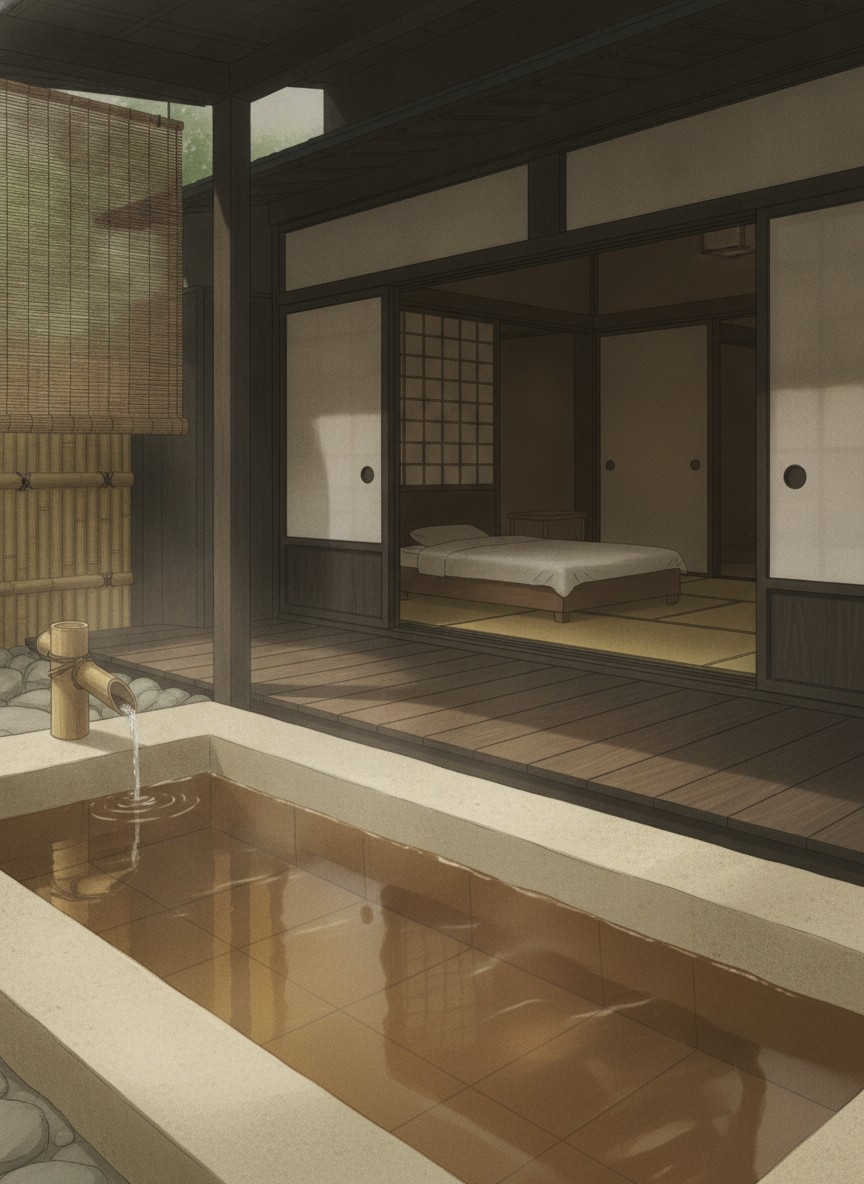
Then the rooms. Kaze, the inn's original open-air bath room and by its account the first in Japan, has its tub out on a wooden terrace beside a day bed. Four bath-living rooms, Keyaki, Sakura, Momiji and Beni, began as open-air baths that were roofed, glazed and furnished with a sofa and bed, so the tub is in the room you sit in. Tsubaki is a two-story cottage with a bath-living room upstairs. Sora and Hikari are wide tatami suites on the river with a semi-open-air indoor bath and a bath veranda. All of them are yours for the stay.
The hotel
Gajoen is a village of old thatched farmhouses dismantled elsewhere, moved here and rebuilt around a lane with chickens underfoot. The rooms page lists eight rooms with a bath of their own and the inn sells ten in all. Dinner is Satsuma farm cooking from vegetables grown on the inn's fields and chickens raised on site. There is a hearth salon with a cafe and bar, the tea room Fubosha, a shop and an esthetic room. Check-in 2 p.m., check-out noon, which is late for a ryokan. Wi-Fi reaches every room. Parking for ten cars.
Good to know
- Check-out is noon, so the room bath gets a long morning.
- Tateyu becomes a free private bath at any hour outside noon to 3 p.m.; ask the desk.
- The bus stops at the gate: the Gajoen-mae stop on the Myoken line, about 25 minutes from the airport.
- Wash at Tateyu before the soda bath, which has no washing place of its own.
Getting there
From Kagoshima-Chuo Station take the JR Nippo Line to Hayato Station; the inn gives no train time. From Hayato or Kareigawa Station the inn is about 15 minutes by car or about 25 minutes by bus to the Gajoen-mae stop at its gate; from Kareigawa alone it is about 10 minutes by car. From Kagoshima Airport it is about 15 minutes by car or about 25 minutes by bus to the same stop. The inn will book a paid taxi on request. Parking for ten cars.
Hayato STN · JR Nippo Main Line (limited express Kirishima)
Not walkable.
Bus about 25 minutes from Hayato Station to the Gajoen-mae stop at the gate; the inn arranges taxis.
Where it is

Myoken Onsen bus stop
- Kyushu Shinkansen 1 hr 18 min
- Kirishima express 38 min
- Shinkansen tickets Seats between any two stations, booked by date.
- JR Kyushu Rail Pass from ¥12,000 · 3, 5 or 7 consecutive days Worth it if you’re coming from Hakata by train.
- Kyushu SunQ Pass Worth it if you’re riding buses around Kagoshima. It covers the airport bus to the spa villages and Myoken and the Kagoshima Kotsu bus from Kirishima-Jingu Station.
- Sakurajima volcano half-day tour Half a day on Sakurajima, the active volcano across the bay from Kagoshima.
- Japan Rail Pass from ¥53,000 · 7, 14 or 21 days For a trip that takes in several regions by Shinkansen and JR lines.
What happens when you arrive
Use the bath in your room, or reserve a private bath.
How we know
Bath layout confirmed, tattoo policy not published Checked on the official site (the hot spring page gives the free private use of Tateyu and the two private baths; the rooms page gives the room baths)
Best for: anyone who wants to sleep in a thatched farmhouse with the bath in the living room and a 20-ton rock tub to themselves after 3 p.m.
Rooms with their own bath: Kaze (type D), the inn's original open-air bath room, with the tub on a half-outdoor wooden terrace beside a day bed, for four; the four bath-living rooms Keyaki, Sakura, Momiji and Beni (type B), where the old open-air bath was roofed and glazed and given a sofa and bed, for three each, with an attic; Tsubaki (type E), a two-story cottage with a box hearth downstairs and a bath-living room upstairs, for six; and the Japanese suites Sora and Hikari (type WS), 24.5 and 25.5 mats on the river with a semi-open-air indoor bath, for five. Tateyu, the men's and women's main bath, has a tub hollowed over six months from a single rock of about 20 tons; outside day use (noon to 3 p.m.) it can be reserved as a private bath free. Utase-yu and Ramune-yu are private baths on a self-rising carbonated spring, free until midnight; wash your hair at Tateyu first. Check-in 2 p.m., check-out noon. Parking for 10 cars. Satsuma farm cooking from the inn's own vegetables and chickens.
Check availabilityBooking through this link costs you nothing extra and earns us a small commission, which keeps this guide free and up to date for our tattoo community. Thanks for your support.