
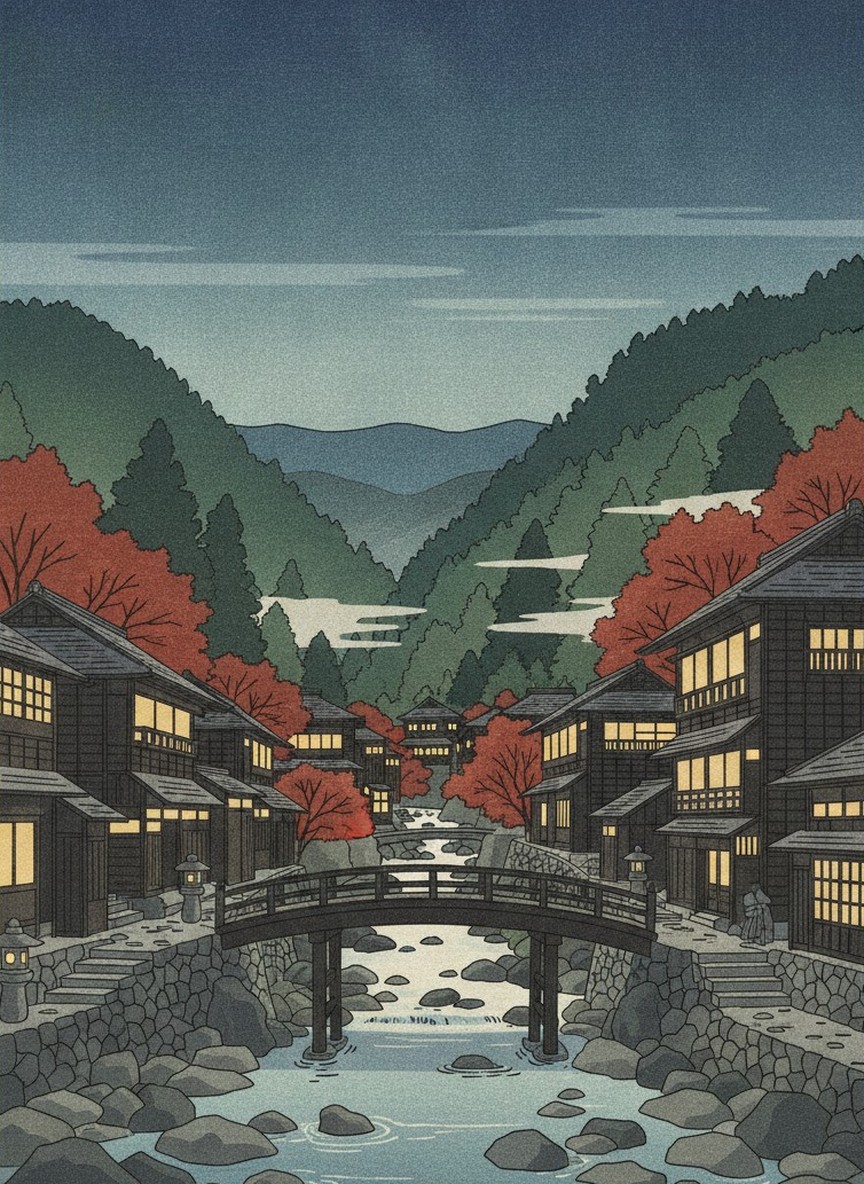
Illustration of Kurokawa Onsen on an autumn evening: wooden inns lit along a shallow river in a wooded valley, with a small footbridge and red maples
Kumamoto · 2 h 40 by coach from Hakata · Onsen town

Tattoo friendly onsen in Kurokawa

Thirty inns along one wooded valley, and a wooden pass that buys three open-air baths at any of them. What the pass does not buy is an answer: the ryokan association says the tattoo rule differs inn by inn, tells you to ask when you book, and points tattooed visitors at private baths. So this page is built on the baths you take alone, and on the two inns that put something in writing.

1 property

No restrictions

Tattoos are welcome in every bath. Nothing to cover, nothing to book. What this means

Kurokawa, up the north side of the valley at the top of the inn strip Ryokan Confirmed

Ryokan Ichinoi

旅館 壱の井

Ichinoi answers the question on its own site, and the answer is that it does not restrict tattoos. Its FAQ says a great many tattooed guests have come and nothing has come of it. No seal, no size limit and no declaration at the desk are mentioned, and the inn draws no line between its own guests and the day bathers it admits with the nyuto tegata.

当館はタトゥーを制限しておりません。今までにタトゥーのある方が沢山お越しいただいてますが、特にトラブルはござません。

Best for: Getting into a shared open-air bath in Kurokawa with nothing covering your skin

Sulfur water with yu-no-hana flakes turning in it. The ryokan association’s live day-use board prices a single visit here at 600 yen and shows the inn closed to day bathers on some days, so read the board the morning you go. Of the thirty member inns, this is the only site that says tattoos are not restricted.

Ryokan Ichinoi tattoo policy → Check availability
16 properties

Private baths only

Tattoos are fine in a private or in-room bath. The communal baths are restricted, or the policy is unconfirmed. What this means

Kurokawa, on the Tanoharu river a short walk below the main lane Ryokan Confirmed

Yumerindo

夢龍胆

Yumerindo is the only member inn that publishes a tattoo rule for the baths it opens to day visitors, and the rule has two halves. Tattooed bathers are turned away from the four large baths, except that a point tattoo, which the inn also calls a fashion tattoo, is allowed if you declare it beforehand and are mindful of other bathers. Anything bigger goes to the family baths, four detached buildings in cypress and cut stone that only staying guests may book, which is why this is filed as a private-bath answer rather than an open one.

タトゥーが入っているお客様は、入浴をお断りいたします※事前に申告の上、周りのお客様に配慮いただける方という前提で ただし、ポイントタトゥー(ファッションタトゥー)であれば入浴を許可するという形をとっております。ご理解ご協力をよろしくお願いいたします

Best for: A traveler with one small tattoo who is willing to declare it at the desk, or anyone who wants a family bath included in the room

Four family baths, staying guests only, 15:00–21:00, booked the same day at the desk. First use is free and each later turn is 1,100 yen per room, with guests on a kashikiri plan taking priority. Day bathing runs 8:30–19:00, last entry 18:30, 660 yen, with numbers capped. On 15 October 2024 the inn ran a “tattoo day” from 11:00 to 18:00 when only tattooed bathers were admitted and everyone else was turned away; its blog post about it restates the standing rule and says the house steers larger tattoos toward the family baths.

Yumerindo tattoo policy → Check availability
Kurokawa, in the middle of the lane by the Tanoharu river Ryokan Confirmed

Fumoto Ryokan and the Rokuan annex

ふもと旅館&別館 麓庵

Fumoto publishes no tattoo rule, and for anyone staying the eleven kashikiri baths settle the matter. All eleven lock from the inside, cost nothing beyond the room, and are used whenever you find one empty, 15:00 to 23:00 and 6:00 to 10:00. The two open-air baths the inn opens to tegata holders are shared, and a day visitor is bathing under a rule nobody has written down.

Best for: Working through a private bath list without booking a single one of them

Eleven private baths across the main house and the Rokuan annex. Five take four or five adults; the rest hold one or two. The deepest is the annex standing bath at 150 cm, which the inn caps at 30 minutes per group. Fourteen rooms in all, two people to a room, and three rooms in Rokuan have an open-air bath of their own. The inn does not accept guests aged 12 or under. Day visits to the two shared open-air baths run on the association board at 600 yen, and the board notes there are no showers in them.

Fumoto Ryokan and the Rokuan annex tattoo policy → Check availability
Kurokawa, on the lane above the Jizo hall Ryokan Confirmed

Okyakuya

歴史の宿 御客屋

No tattoo rule is published, and the two kashikiri baths carry the answer. Ichi-no-yu in cypress and Ni-no-yu in cut stone each hold two adults and each have their own changing room, and the inn says no reservation and no bathing fee apply: lock the door whenever one is free. The other five baths rotate between men and women, and day visitors paying 700 yen use them under nothing published.

Best for: A locking bath you can take twice in an evening without asking anyone

Seven bathing places on the inn’s own sulfate and chloride source, in use 6:00–23:00. Sato-no-yu, for staying guests, has a 130 cm standing bath you hold two logs in. Daikan-no-yu and Ko-no-yu were rebuilt in July 2025. Day visits 10:30–19:00, last entry 18:30, 700 yen for adults and 300 for children, though the association board showed the inn closed on the day checked. The house has been an inn since 1722 and served the Hosokawa lords.

Okyakuya tattoo policy → Check availability
Kurokawa, at the river crossing in the center of the village Ryokan Confirmed

Shinmeikan

山の宿 新明館

Shinmeikan publishes nothing about tattoos, but it is one of the few member inns that hires a private bath to people who are not staying. Kajika-no-yu, a family bath, goes to day visitors from 12:00 to 15:00 at 1,500 yen for 40 minutes. Staying guests can reserve Kaze-no-yu, the open-air family bath, from 15:30 and take it free after 22:00. The cave baths and the riverside Iwato-buro are shared and carry no published rule.

Best for: Hiring a private bath in Kurokawa for 40 minutes without booking a room

The cave bath is the reason people know the name: the inn says its first owner dug about 30 meters into the rock with a single chisel over 13 years. Iwato-buro, alongside the river, is the oldest open-air bath in Kurokawa. Day bathing in the caves and Iwato runs 10:30–15:00, last entry 14:30, 500 yen, with numbers capped and hours shortened; the association board carries the day’s actual times.

Shinmeikan tattoo policy → Check availability
Kurokawa, downstream of the village under the Byobu-iwa rock face Ryokan Confirmed

Kurokawa-so

黒川荘

Three family baths named Ichi, Ni and San-no-yu are booked at the front desk in 50-minute turns, free to staying guests and 2,500 yen to anyone not staying. That second figure matters, because the ryokan association’s own FAQ says day-use private baths in Kurokawa generally cannot be reserved, and here they can. No tattoo rule is published for the shared open-air baths, which day bathers may also use for 700 yen.

Best for: Reserving a locking bath as a day visitor, which most of the valley will not do

Family baths are taken at the desk in person; the inn does not accept telephone bookings for them, and a day visitor should check availability before buying a ticket. Reception for them runs 10:30–20:30. The shared open-air baths are open to tegata holders 10:30–21:00, last entry 20:30. Some rooms were rebuilt with an open-air bath of their own. The inn puts itself about 15 minutes on foot below the center of the village and warns that stairs connect everything.

Kurokawa-so tattoo policy → Check availability
Higashi-Oku-Kurokawa, upstream of the village where the spring water rises Ryokan Confirmed

Genryu no Yado Hozantei

源流の宿 帆山亭

Eleven detached rooms, and the inn says every one of them has a hot spring bath of its own filled from the inn’s own source. That is the whole answer here: no tattoo rule is published, and a guest never has to get into shared water. Tengu-no-yu, the large open-air bath, is the shared one, and day visits to it need a telephone call first.

Best for: Bathing alone at the top of the valley, well away from the day-trip crowd

One room, Sanbo-no-yu, has an indoor bath instead of an open-air one. Water is 100 percent from the inn’s own source, a simple sulfur spring. Guests use the big open-air bath 7:00–10:00 and 15:00–21:00; day visits are 11:00–15:00 and the inn asks you to phone ahead, and the association board listed it closed on the day checked, at 800 yen when open. Furthest from the village of any member inn, so allow for the drive.

Genryu no Yado Hozantei tattoo policy → Check availability
Kurokawa, on the high ground north of the village Ryokan Confirmed

Kounoyu

こうの湯

Every one of the nine rooms has an open-air or semi-open-air bath of its own, so a tattooed guest here bathes alone without asking for anything. There is also Ten-no-yu, a private open-air bath kept for staying guests, reserved at the desk and held for up to 50 minutes. Mori-no-yu, the big men’s and women’s bath with the deep standing pool, is shared and no tattoo rule is published for it.

Best for: A room where the bath is on your own deck and the shared one is optional

Four rooms are free-standing and five are set in a terraced row. The inn measures the men’s standing bath in Mori-no-yu at 1.62 meters at its deepest and calls it the deepest in Japan; the women’s side has its own at 130 cm with a wooden bar hung from the ceiling. Ten-no-yu runs 15:00–22:00 and 7:00–9:00 and lends face towels only. Sister inn of Fumoto Ryokan. Day visits are listed on the association board at 700 yen, 8:30–21:00, last entry 20:30.

Kounoyu tattoo policy → Check availability
Kurokawa, in the trees a few minutes above the village lane Ryokan Confirmed

Oyado Noshiyu

お宿 のし湯

Five private baths, every one of them reserved for people staying: the tucked-away Soroku-no-yu, a standing bath about 120 cm deep, the outdoor Tsuki-no-yu, and two indoor family baths called Konara and Momiji. They are open from check-in to 22:00 and again 6:30 to 10:30. Six of the eleven rooms have a bath of their own as well, so the two shared open-air baths, which carry no published tattoo rule, can be skipped entirely.

Best for: A stay where the private baths outnumber the shared ones

Room types with their own bath include Azami, Shion, Yamabuki, Kaze, Konomi and Kiri, the last a semi-open-air bath with a terrace. The owners dug and built the baths themselves from 1993 onward. Day visitors are taken 15:00–18:00 for the men’s and women’s open-air baths, 600 yen on the association board, and the tegata is accepted.

Oyado Noshiyu tattoo policy → Check availability
Kurokawa, built up the slope over the village rooftops Ryokan Confirmed

Ryokan Nanjoen

旅館 南城苑

Three of the twelve rooms have a semi-open-air bath of their own fed straight from the source, one each on the first, third and fourth floors, and those are the rooms to ask for by name. The inn publishes no tattoo rule for its shared baths, so the room bath is the reliable answer rather than the assumption that silence means permission.

Best for: A room bath over the rooftops at a price below the private-bath ryokan up the valley

The three bath rooms sleep two to five and pair an eight-mat tatami room with a separate bedroom and a wide window seat cut from a single plank. Twelve rooms in five types overall. The association day-use board lists the inn at 600 yen and showed it closed for day bathing on the day checked, so treat the shared baths as a bonus rather than a plan.

Ryokan Nanjoen tattoo policy → Check availability
Kurokawa, on the lane at the lower end of the village Ryokan Confirmed

Fujiya

ふじ屋

Two family baths, both rock-lined and sized for two adults, and the inn tells guests to use them at any hour they please during their stay. Nothing to book, nothing to pay, nothing to declare. The men’s and women’s baths are shared and the inn publishes no tattoo rule for them.

Best for: A quiet private soak at any hour without a reservation sheet at the desk

An acidic iron-bearing spring at 53°C, diluted a little for temperature, which the inn says turns white or brown depending on the weather and the water. Sen-no-yu is the men’s bath in cypress; Chihiro-no-yu, the women’s, has a semi-open-air section, a lying-down bath and a mist sauna.

Fujiya tattoo policy → Check availability
Kurokawa, above the river on the Kitakurokawa side Ryokan Confirmed

Yukyo no Hibiki Yusai

湯峡の響き 優彩

Seven bathing places, two of which lock: Sugi-no-yu, which the inn describes as step-free, and Nagomi-no-yu, both indoor and both kept for staying guests. Special rooms with an open-air bath attached are the other way to bathe by yourself. The four large baths and three open-air baths are shared, two of them with day visitors, and no tattoo rule is published for any of them.

Best for: A larger hotel-scale inn where the private baths are included rather than charged for

The inn calls its bathing floor among the largest in Kurokawa: four indoor baths, three open-air, two of them shared with day bathers. Day visits run 15:00–21:00, last entry 20:30, 600 yen on the association board, and the inn says it may turn day bathers away when the baths are busy. Its sister house, Yusai Bekkan, is a separate listing and a separate bath.

Yukyo no Hibiki Yusai tattoo policy → Check availability
Kurokawa, about seven minutes on foot from the bus stop Ryokan Confirmed

Ryokan Misato

和風旅館 美里

Misato keeps a family bath open from 6:00 to 21:00, last entry 20:00, and that is the private answer here, since none of the twelve rooms has a bath of its own. The inn publishes no tattoo rule for the open-air baths it opens to tegata holders. It also publishes no price or booking method for the family bath, so settle that at the desk when you arrive rather than assuming it is free.

Best for: An early family bath before the day trippers reach the valley

A sulfur, chloride and sulfate spring that the inn says changes color by itself through the day, running clear, pale blue, blue, emerald green and milky white. The open-air baths hold nine people a side and sit between the first and second floors, up a flight of stairs from the rooms, and the inn asks guests to carry towels from the room. Twelve rooms, five Japanese and seven Japanese-Western. Day visits 700 yen on the association board, which showed the inn closed on the day checked.

Ryokan Misato tattoo policy → Check availability
Kurokawa, on the west side of the village above the Tanoharu river Ryokan Confirmed

Yamabiko Ryokan

やまびこ旅館

Six family baths, and the inn states the terms without hedging: no reservations, no time slots, free of charge, day or night, for anyone staying. They include a standing bath at 150 cm, a round tub cut from marble, a step-free lying bath with a handrail and a pair of cypress tubs sized for a parent and child. Sennin-buro, the huge open-air bath, is shared and carries no published tattoo rule, and day visitors are admitted to the open-air baths only.

Best for: Having six private baths to work through with no sign-up sheet and no clock

The inn calls Sennin-buro the largest open-air bath in Kurokawa and runs it in two sizes, the smaller one deeper. Open-air baths swap between men and women at midnight, and are closed in turn for cleaning. Day visits to the women’s Sennin-buro run 8:30–21:00, last entry 20:30, 700 yen on the association board. The inn also takes dogs in a separate annex.

Yamabiko Ryokan tattoo policy → Check availability
Oku-Kurokawa, up the valley beside the Hiyakiwachi stream Ryokan Confirmed

Sato no Yu Waraku

里の湯 和らく

Every room at Waraku has a bath of its own, and the inn describes it plainly: open the windows wide and it becomes a half-open-air bath, yours at any hour and for as long as you want. Rooms take two adults and nobody else, so the water in them is never shared with strangers. The two communal baths, an outdoor one among boulders and a cave bath, are also sold to day visitors, and no tattoo rule is published for either.

Best for: Two people who want the bath inside the room and the valley to themselves

Detached rooms, adults only, two to a room. The spring is a sulfur-bearing sodium chloride and sulfate water, which the inn gives as 90°C at the source and 100 liters a minute. Day visitors get the outdoor bath and the cave bath Oku-no-Seseragi, which swap between men and women by the hour: the inn’s own page gives 11:00–14:00, last entry 13:30, at 600 yen for adults and 300 for children aged three and up, while the association’s live board has listed longer hours with a break between 14:00 and 15:00, so read the board on the day.

Sato no Yu Waraku tattoo policy → Check availability
East of the village, spread over its own hillside on the Tanoharu river Ryokan Confirmed

Ryokan Okunoyu

旅館 奥の湯

Three of the nine baths lock, and all three are held for people staying: Ajisai-no-yu indoors in wood, Momiji-no-yu under a maple, and Take-no-yu, a small open-air family bath. They open 15:00 to 23:00 and again 7:00 to 9:30. The inn publishes nothing about tattoos, and everything else on the site is shared water, including several baths it runs as mixed bathing with a women-only spell from 20:00 to 22:00.

Best for: A stay where the private baths are separate buildings rather than a corner of the bathhouse

Nine bathing places on about two thousand tsubo of ground, all on the inn’s own source, which it gives as 95°C at the wellhead. The shared set runs to a thatched-roof open-air bath, a river bath, a cave bath, a large indoor bath, a women-only open-air bath, a cypress bath and a mist sauna. Day visitors are received 8:30 to 14:00 and must be out by 15:00 at 700 yen, with no parking for them; the association board notes a bathing garment is lent for 500 yen for the mixed bath. The three private baths are not part of the day-use offer. The inn sells the nyuto tegata.

Ryokan Okunoyu tattoo policy → Check availability
Kurokawa, a four-story house in the middle of the village Ryokan Confirmed

Ryokan Yamanoyu

旅館 やまの湯

Two of the private baths here are indoor and need no booking at all: the inn says take one whenever it is free, 6:30 to 24:00, one of them filled as a herbal bath and the other as a charcoal bath. The open-air private bath is arranged on the day at the front desk, choosing a slot off a sheet. Day visitors are let into the shared open-air bath only, and nothing is published about tattoos there.

Best for: The cheapest bed in the middle of Kurokawa with a private bath that needs no reservation

None of the rooms has a bath: they run from a six-mat single room to a fourteen-mat room for six, most looking onto the river. The shared open-air bath has no showers, and a dryer only on the women’s side. The inn’s own day rate is 500 yen for adults and 300 for children, 8:30–10:00 and 13:00–21:00, and it asks day visitors to telephone first because cleaning can keep the baths shut until 16:00; the association board lists the inn at 600 yen with a 20:30 last entry.

Ryokan Yamanoyu tattoo policy → Check availability
Traveler’s note The nyuto tegata, the cedar disc sold at any member inn for 1,500 yen, is good for six months and buys three open-air baths out of twenty-five. It is the reason most people come, and it is worth knowing that it carries no policy with it: each inn decides at its own door. The association’s own answer to the question is to write to them with the details before you book, and its own fallback is a bath you do not share.
Getting there

Tickets for the ride in

Sold on Klook. Booking through these links costs you nothing extra and sends a small commission our way.

Common questions

Kurokawa questions

Does the bath-hopping pass let me into the baths with a tattoo?

Not by itself. The pass buys three open-air baths among the member inns, and the association says plainly that each inn handles tattoos its own way and asks you to contact them first. One inn on this page publishes an unconditional welcome; another admits a small tattoo declared in advance. For the rest, the pass gets you to the door and no further than the inn allows.

What is the tegata, exactly?

A cedar disc, 1,500 yen for adults and 700 for children, sold at any member inn and at the association office. It carries three stickers, each good for one open-air bath, and it is valid for six months, so unused stickers keep for another visit. One sticker can be spent on food or a souvenir at a listed shop instead of a bath.

Can I bathe privately here without asking anyone?

At several of these inns, yes. A few keep private baths that take no booking at all: you look to see whether the door is free and use it. Others book them at the front desk after check-in, free to guests, and a couple sell a turn to day visitors.

How do I get to Kurokawa?

There is no railway. The direct coach from Fukuoka runs three times a day from Tenjin by way of Hakata Bus Terminal and Fukuoka Airport’s international terminal, about two hours and forty minutes. From Kumamoto the Kyushu Odan bus crosses by Aso, and carries on to Yufuin and Beppu, which makes a two-town trip simple.

More places to bathe

Other guides

All eighteen guides are live.